
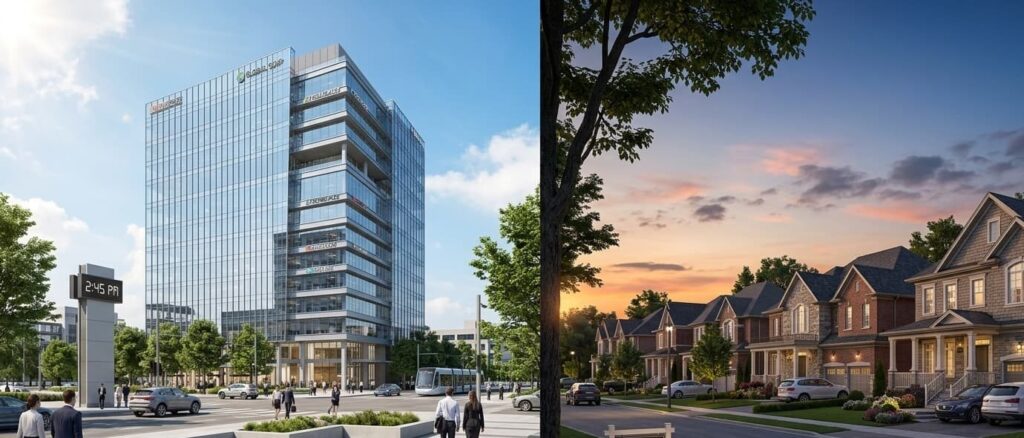
Quick Summary
This comprehensive comparison highlights the core differences between investing in residential and commercial real estate in Greater Noida. While residential investments provide high security, lower entry barriers, and stable capital appreciation, commercial properties deliver superior rental yields, long-term corporate leases, and high cash flow. Learn how infrastructure developments, including the Noida International Airport, are transforming the investment dynamics across different sectors in Noida and Greater Noida.
Table of Contents
- Introduction to Greater Noida Real Estate Landscape
- Residential Real Estate Investment in Greater Noida
- Commercial Real Estate Investment in Greater Noida
- Head-to-Head Comparison: Residential vs Commercial
- Strategic Investment Zones in Greater Noida
- How to Choose the Right Investment for Your Portfolio
- Future Outlook of Greater Noida Real Estate Market
Introduction to Greater Noida Real Estate Landscape
Greater Noida has emerged as a premier urban hub in Northern India, presenting an exceptional model of planned development, broad roads, and systematic zoning. Designed to absorb the population overflow from the national capital, this region has shifted from a quiet residential alternative to a major center of commercial, industrial, and residential activity. The master plan of the region emphasizes open green spaces, high-speed road networks, and dedicated sectors for specific economic activities, making it an attractive destination for individual buyers, corporate entities, and seasoned real estate investors alike.
The growth trajectory of this region is heavily tied to major infrastructure upgrades. The construction of the Noida International Airport at Jewar is a primary factor driving real estate speculation and actual end-user demand. Concurrently, the expansion of the Aqua Line Metro, the widening of the Yamuna Expressway, and the construction of the Eastern Peripheral Expressway have vastly improved regional logistics and passenger transit. These physical connections have integrated the city into the wider National Capital Region, converting local sub-markets into major nodes of high-value investment. As capital flows into this market, the classic debate between residential and commercial investment becomes highly relevant for portfolio growth.
Choosing between these two asset classes requires a deep understanding of market yields, capital appreciation dynamics, legal frameworks, and tenant behavior. Residential properties offer stability, personal utility, and steady value increases over time. On the other hand, commercial properties offer higher rental yields and long-term corporate leases, but they come with higher entry barriers and vacancy risks. Analyzing these factors with precision helps investors make informed decisions aligned with their financial goals, holding periods, and risk appetites.
Residential Real Estate Investment in Greater Noida
What is driving the demand for residential properties in Greater Noida?
The demand for housing in Greater Noida is fueled by a combination of relative affordability, high-quality infrastructure, and a growing employment base. As employment centers expand along the Noida-Greater Noida Expressway and within the local knowledge parks, professionals are actively seeking homes close to their workplaces. This has created a self-sustaining cycle where corporate investment directly feeds the residential rental and purchase markets. The region offers a level of planned infrastructure and open space that is difficult to find in older parts of Delhi or densely packed areas of neighboring cities.
Another factor is the search for an improved lifestyle. Modern residential projects in this area feature vast green reserves, clubhouses, sports facilities, and security systems. Families are increasingly drawn to these integrated ecosystems, driving steady transaction volumes. Investors looking for capital preservation and stable growth see the area as a safe harbor. By investing in premium residential properties in Delhi NCR, buyers can secure assets that stand to benefit from the continuous influx of families migrating from more congested urban zones.
Average pricing, rental yields, and appreciation potential for homes
Historically, residential real estate in Greater Noida has been known for consistent, moderate rental yields, typically ranging between 2% and 4% annually. While these yields may seem modest compared to commercial assets, the main strength of residential investments lies in capital appreciation. Over the last decade, property prices in well-connected sectors have shown steady upward growth. This trend has accelerated recently as infrastructure projects near completion, leading to double-digit annual appreciation in prime locations.
The pricing structure is diverse, accommodating middle-income buyers as well as luxury investors. High-rise apartments in sectors like Greater Noida West offer highly competitive entry points, whereas premium low-density projects command high premiums. Because the cost of land acquisition is rising steadily, the cost of entry is projected to climb, meaning early investors are positioned to capture the greatest share of long-term appreciation. Additionally, the resale market is highly active, providing residential investors with greater liquidity compared to specialized commercial spaces.
Types of residential properties: Apartments vs independent villas
The residential market is divided into high-rise apartments, plotted developments, and luxury independent villas. High-rise apartments appeal to mid-market buyers due to their lower maintenance costs, shared amenities, and lower initial capital requirements. These projects provide stable rental demand from young working professionals and families who value community amenities such as swimming pools, gyms, and round-the-clock security systems.
However, there is a clear and growing preference for exclusive luxury spaces. High-net-worth individuals and corporate executives are increasingly opting for independent villas and low-density estates. These properties offer unmatched privacy, customized design layouts, and direct land ownership, which historically appreciates faster than built-up apartment space. When choosing these luxury assets, buyers lean heavily on developers with a track record of timely delivery and premium craftsmanship. Aligning with a developer backed by the Heritage Prime legacy of trust ensures that the physical construction and title clearances are of the highest standard, protecting the capital investment for generations.
Commercial Real Estate Investment in Greater Noida
What makes commercial spaces in Greater Noida attractive to investors?
The commercial market in Greater Noida is driven by rapid industrialization, the establishment of massive IT parks, and favorable government policies. The region has become a major destination for mobile manufacturing, electronics units, data centers, and automotive industries. This industrial growth brings a highly skilled, high-earning workforce, which in turn fuels the demand for premium retail environments, food courts, and corporate office spaces. The systematic planning of the city ensures that commercial sectors are located near major transit corridors, maximizing visibility and foot traffic.
Additionally, major multinational corporations have established large offices here, attracted by modern structures, uninterrupted power supply, and affordable rents compared to Gurugram or Central Delhi. As these corporate hubs grow, they create a strong consumer base for nearby retail developments. For investors, this commercial ecosystem represents an opportunity to tap into institutional-grade real estate that benefits from regional economic expansion and steady demand from corporate tenants.
Rental yields and long-term lease structures in the commercial sector
One of the primary reasons investors choose commercial assets over residential is the superior yield profile. Commercial properties in Greater Noida generally deliver annual rental yields between 6% and 9%. These yields are supported by professional lease agreements, which typically span 3 to 9 years and include pre-negotiated rent escalation clauses, often 15% every 3 years. This provides a highly predictable, inflation-protected stream of passive income.
Additionally, commercial leases often operate on a triple-net basis (NNN), where the corporate tenant covers operational costs, insurance, property taxes, and maintenance fees. This significantly reduces the management burden on the owner. While the initial capital required for commercial real estate is higher, the recurring income stream and professional tenant interactions make it a highly efficient vehicle for wealth generation and cash-flow management.
Sub-segments: Retail shops, office spaces, and IT parks
The commercial sector contains several distinct sub-segments, each with its own risk-return profile. Retail spaces, particularly ground-floor high-street shops in high-density areas, are highly coveted because they command the highest rental rates and benefit from continuous consumer footfall. Corporate office spaces and IT parks offer stable, long-term rentals from institutional tenants, though they are more sensitive to broader economic trends and corporate real estate strategies.
Investors often diversify across these sub-segments to optimize their portfolios. It is common to see high-net-worth individuals balance their real estate investments by holding both residential and commercial assets. For instance, those who purchase premium villas for sale in Noida to secure their family housing needs often allocate their corporate surpluses to premium retail spaces in Greater Noida. This balanced approach protects their capital through residential appreciation while generating high-yield cash flow from commercial retail leases.
Head-to-Head Comparison: Residential vs Commercial
Financial metrics comparison
To evaluate these asset classes objectively, investors must look at their core financial characteristics. The table below outlines the primary metrics that define residential and commercial properties in the current Greater Noida market:
| Metric | Residential Properties | Commercial Properties |
|---|---|---|
| Initial Capital Requirement | Moderate to high (flexible options available) | High (requires substantial upfront investment) |
| Average Rental Yield | 2% to 4% annually | 6% to 9% annually |
| Lease Duration | Short-term (typically 11 to 24 months) | Long-term (3 to 9 years with lock-in clauses) |
| Appreciation Potential | High (steady and continuous growth) | Moderate to high (linked to business activity) |
| Maintenance & Upkeep Cost | Paid primarily by owner (unless negotiated) | Paid primarily by tenant (Triple-Net Leases) |
| Tenant Profile | Individuals, families, student groups | Corporations, retail brands, enterprises |
Risk assessment and liquidity comparison
The risk profiles of these two asset classes are distinct. Residential properties are generally considered lower-risk defensive assets. Even during economic downturns, the basic human need for shelter maintains a baseline demand for residential rentals and sales. If a residential property becomes vacant, finding a new tenant is usually a matter of weeks, minimizing cash flow disruptions. Furthermore, individual homes and well-structured communities like the Palm Villas Noida gated community retain their underlying land value remarkably well, serving as highly dependable wealth preservation tools during inflationary cycles.
In contrast, commercial properties carry higher risk but offer greater financial rewards. A commercial vacancy can last for several months or even years, especially during economic slowdowns, during which the owner must cover carrying costs, taxes, and security. However, when occupied by a creditworthy tenant, commercial real estate provides exceptional, hands-free income. To mitigate these risks, modern investors often split their allocations, placing a portion into secure, well-managed luxury residential developments, such as the Shyam Kunj Villas luxury township, while reserving the rest for commercial projects to achieve an ideal balance of safety and yield.
Strategic Investment Zones in Greater Noida
Sector-specific analysis
To maximize returns, investors must carefully choose their target micro-markets within Greater Noida, as different sectors cater to specific investment strategies. Greater Noida West, commonly known as Noida Extension, is a prime hub for residential investments. Its massive housing inventory, competitive pricing, and growing commercial high streets make it highly popular with young professionals. The continuous addition of retail options in this sub-market ensures that residential developments here have strong rental demand and steady appreciation potential.
Pari Chowk, the oldest and most established entry point to Greater Noida, remains a high-value zone for both residential and commercial assets. Its proximity to major educational institutions, direct metro access, and mature surrounding infrastructure make it a highly stable option with low vacancy rates. On the other hand, the Yamuna Expressway sector is the primary choice for long-term speculative and commercial investments. This corridor is designed to host massive industrial hubs, toy parks, and aviation services centered around the upcoming airport. Investing in commercial land or industrial-use properties along this highway offers exceptional long-term growth potential as economic activity intensifies over the next decade.
How to Choose the Right Investment for Your Portfolio
Aligning with financial goals and capital availability
Deciding between residential and commercial investments in Greater Noida depends on your financial objectives, capital availability, and how much time you want to spend managing the property. If your primary goal is regular, high monthly cash flow and you have a substantial capital pool, commercial real estate is the logical choice. The high rental yields, combined with long-term corporate leases, provide a steady stream of income that can support other investments or fund retirement. However, you must be prepared for longer vacancy periods and a more complex acquisition process.
Conversely, if your goal is long-term wealth accumulation, personal security, and capital preservation with lower management effort, residential properties are highly suitable. Residential investments are easier to finance, require less initial capital, and are highly liquid. They also offer unique tax benefits on home loan interest payments under Section 24b and principal repayments under Section 80C. This makes residential properties highly attractive for salary-earning professionals looking to build an asset base while managing their annual tax liabilities.
Future Outlook of Greater Noida Real Estate Market
Impact of upcoming infrastructure on long-term growth
The long-term outlook for Greater Noida is highly positive, driven by sustained infrastructure spending and planned commercial expansions. The commercial operationalization of the Noida International Airport will be a transformative event, repositioning the entire region as a major international transit and logistics hub. This development will attract multinational corporations, hospitality chains, and retail brands, driving up the value of surrounding commercial properties.
Simultaneously, the residential market will benefit from the improved connectivity and employment opportunities created by the airport and its associated industrial zones. As the city matures, the price gap between Greater Noida and older NCR cities will continue to shrink. Whether you choose the cash-flow advantages of commercial spaces or the stable growth of residential properties, Greater Noida offers a highly modern, planned environment that supports long-term wealth generation for forward-looking real estate investors.
Frequently Asked Questions
Is residential property safer than commercial property in Greater Noida?
Yes, residential property is generally considered safer due to lower vacancy risks and stable demand for housing. Even during economic downturns, people require shelter, which maintains rental and resale demand. Commercial properties offer higher yields but are more sensitive to economic cycles and can experience extended vacancy periods.
What is the average rental yield for commercial properties in Greater Noida?
Commercial properties in Greater Noida typically offer rental yields between 6% and 9% annually. This is significantly higher than the 2% to 4% yields commonly found in the residential sector, making commercial real estate highly attractive for cash-flow-focused investors.
How does the Noida International Airport impact real estate in Greater Noida?
The Noida International Airport at Jewar is a major driver of growth, boosting demand for both commercial and residential properties. It is attracting large multinational companies, industrial units, and logistics operators to the region, which increases job opportunities and drives up property values and rental demand along major corridors like the Yamuna Expressway.
Can individual investors purchase fractional shares in commercial properties in Greater Noida?
Yes, individual investors who find the high entry cost of commercial real estate prohibitive can explore fractional ownership models or Real Estate Investment Trusts (REITs). These structures allow investors to own a share of high-grade commercial assets in Greater Noida with a much smaller capital outlay, while still enjoying proportional rental income and capital appreciation benefits.