
Quick Summary
This editorial explores professional-grade lighting design strategies specifically tailored for modern luxury villas. It covers the technical division between architectural and decorative illumination, details practical methods for staging foyer and living spaces, outlines high-end circadian schemes for master suites, and analyzes exterior structural accentuation. Additionally, it provides a comprehensive breakdown of automated control systems to achieve flawless ambience across expansive residential floorplans.
Principles of High-End Residential Lighting Design
Illumination is the silent author of space. In high-end estates, lighting design operates not merely as a functional utility but as a primary structural element. The primary objective of professional lighting design in custom estates is to accentuate spatial volume, celebrate material textures, and direct the human eye to curated focal points. When executing a lighting plan for premium residential properties in Delhi NCR, the interaction between natural light and artificial sources requires meticulous calibration from the very early stages of architectural drafting.
How does architectural lighting differ from decorative lighting in high-end estates?
Architectural lighting is integrated directly into the physical structure of the villa, remaining largely invisible while performing the heavy lifting of spatial definition. This category includes trimless plaster-in downlights, linear LED plaster-in profiles, floor-recessed uplights, and hidden cove details. The sole purpose of these fixtures is to model the architecture, wash walls with uniform light, and reveal texture without presenting any visual clutter. It relies heavily on high-performance optics, low-glare deep baffles, and precise beam angles to shape the light cone exactly where it is needed.
In contrast, decorative lighting serves as the visual jewelry of the residence. These are the highly visible chandeliers, pendant lights, articulated wall sconces, and sculptural floor lamps that establish the stylistic language of the interiors. Decorative pieces do not aim for high-efficiency illumination, instead, they provide visual warmth, create points of interest, and establish scale. An exceptional luxury lighting scheme successfully marries these two methodologies, ensuring that the decorative fixtures do not work in isolation but are balanced by hidden, high-precision architectural elements.
Why is layered lighting fundamental to luxury home interiors?
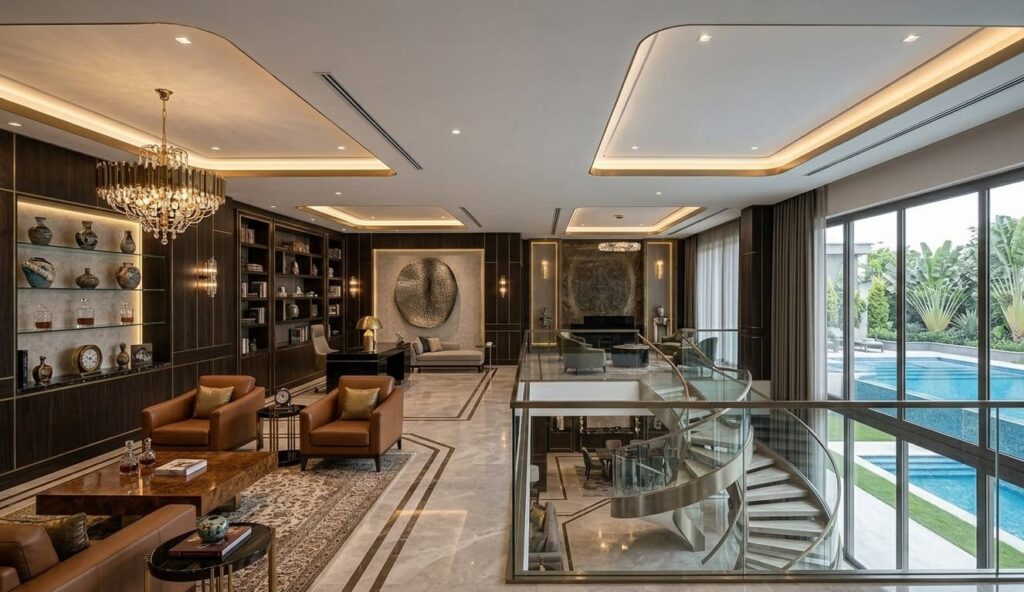
Single-source illumination is the enemy of premium residential design. To create a sense of depth, comfort, and luxury, designers utilize a three-layered approach comprising ambient, task, and accent lighting. Ambient lighting provides the overall soft glow that allows safe movement throughout the space. It acts as the foundation, typically achieved through indirect sources such as cove lighting, which bounces light off the ceiling to prevent harsh shadows.
Task lighting introduces focused illumination to areas where specific activities occur, such as kitchen islands, home offices, or dressing rooms. This layer requires careful attention to glare control and color rendering. Accent lighting, the final layer, injects drama and dimension by highlighting architectural features, columns, alcoves, and fine art. By controlling each layer through independent dimming channels, homeowners can adjust the visual balance of a room to suit different times of the day, moods, or social events.
Entrance and Foyer Lighting: Creating a Grand First Impression
The entrance foyer sets the tone for the entire residence. In a luxury villa, this zone must balance dramatic scale with inviting warmth. The lighting in a grand entrance must guide visitors inward while showcasing the home’s primary architectural volume, whether it is a soaring double-height vestibule or a wide, sweeping gallery.
What lighting fixtures work best for double-height entrance lobbies?
Double-height entrance halls demand light fixtures of monumental scale that match the vertical volume of the architecture. A custom-designed suspended sculptural chandelier or a cluster of hand-blown glass pendants serves as an exceptional anchor. When placing a heavy decorative fixture, it is critical to ensure it is positioned at an elevation that is visible both from the ground floor entryway and from the upper-level gallery or mezzanine overlooking the foyer.
At the Palm Villas Noida gated community, double-height foyers are designed with dedicated structural reinforcement in the ceilings to support complex, multi-tiered crystal and brass installations. To complement these focal fixtures, designers integrate narrow-beam, high-output plaster-in downlights located at the ceiling level. These downlights project crisp shafts of light downward, illuminating the floor plane and preventing the center of the room from feeling dark or cavernous.
How do we integrate subtle accent lighting in luxury corridors?
Corridors and transition spaces in grand homes should never feel like dark tunnels or overly bright commercial hallways. Instead, they should be treated as galleries. Integrating low-level, step-recessed wall luminaires that cast soft pools of light across the floor surface creates an elegant, low-glare pathway. These step lights should be installed approximately fifteen to thirty centimeters above the finished floor level.
Additionally, wall washing represents an excellent technique for corridors. By placing asymmetric recessed linear fixtures or adjustable downlights very close to the wall surface, you can wash vertical planes in light, making the corridor feel wider and more spacious. If the corridor features textured stone wall panels, wood detailing, or hand-painted wallpaper, this grazing technique emphasizes the three-dimensional quality of the materials.
Living Room and Salon Illumination Strategies
The main living room, or formal salon, is the social heart of a luxury villa. It is a multi-functional space where family members gather, guests are entertained, and rare art collections are displayed. As a result, the lighting plan must be highly versatile, offering scenes that transition effortlessly from bright daytime clarity to intimate evening warmth.
How can custom cove lighting transform the spacious living area?
Cove lighting is a classic architectural lighting technique that uses concealed LED strips located within ceiling recess detailings to bounce light off the ceiling and back down into the room. This indirect lighting method softens the overall atmosphere of the room, eliminating harsh contrasts and distracting shadows. It also gives the illusion of a floating ceiling, which adds height and structural elegance to the room.
To execute this correctly, the LED strips must be placed inside a knife-edge cove or a custom plaster profile with a depth that hides the individual LED diodes from all viewing angles. High-density LED tapes with at least 120 or 240 diodes per meter are recommended to ensure a continuous, unbroken line of light without any visible hot spots. Opting for a warm, dimmable LED strip that ranges from 2200 Kelvin to 3000 Kelvin allows you to change the color temperature as night approaches, matching the natural rhythm of outdoor light.
What is the ideal way to highlight fine art and sculptures with light?
Illuminating high-value art collections requires specialist lighting instruments with high Color Rendering Index values of 95 or above, with a specific focus on the R9 value, which represents saturated red tones. For canvas paintings, the standard choice is an optical framing projector. These high-precision luminaires are completely recessed into the ceiling and feature adjustable internal lenses and framing shutters. They allow the light beam to be shaped precisely to the borders of the canvas, making the artwork appear as though it is glowing from within.
For three-dimensional sculptures, designers utilize a dual-direction lighting approach to prevent the art from looking flat. This involves placing a narrow-beam spotlight from the top front, paired with a softer counter-light from the opposite side or the floor level. This technique accentuates the depth, curves, and material texture of the sculpture. In many premium luxury independent villas in Noida, track-mounted or adjustable semi-recessed spotlights are highly favored for their flexibility, allowing homeowners to rearrange their art collections without having to modify the fixed lighting structure of the villa.
Master Suite and Private Retreat Lighting
In the private quarters of a luxury villa, lighting must transition from a display of architectural scale to an intimate, restorative sanctuary. The master bedroom suite requires intuitive control and soft, warm tones that prepare the mind and body for rest, while the adjoining walk-in closets and master bath demand highly precise, functional light.
How do you achieve a boutique hotel ambience in villa bedrooms?
To mimic the serene atmosphere of five-star hospitality design, bedrooms must move away from central ceiling-mounted downlights. Downlights positioned directly over a bed cause glare when a person is lying down, disrupting sleep patterns. Instead, the lighting should be shifted to the perimeter of the room, utilizing warm LED cove details, wall sconces, and soft bedside reading lights.
Low-level night lighting is another essential element. Incorporating motion-activated, warm-dim LED strips underneath the floating bedside tables, under the bedframe, or along the floor plinth of the bathroom door provides a gentle path of light for nighttime movement. This extremely soft light, ideally set at a very warm 2200 Kelvin, ensures that residents can navigate their suite safely in the dark without triggering high-intensity main lights that disrupt sleep cycles.
What vanity and functional lighting designs suit luxury walk-in closets?
A luxury walk-in closet is a showcase for haute couture, requiring lighting that mimics the high-end retail experience. Overhead lighting alone is insufficient, as it casts harsh shadows on the face when looking in a mirror and leaves clothes on lower shelves in darkness. The most effective solution is the integration of vertical LED profile lights directly into the cabinet joinery.
These profiles are recessed into the side panels of the wardrobes, directing light inward to illuminate garments uniformly from top to bottom. For vanity mirrors, side-lighting is paramount. Placing linear wall sconces or integrated vertical LED bars on both sides of the mirror at eye level ensures balanced, shadow-free illumination across the face, which is perfect for makeup application and grooming. The light sources here must feature a high Color Rendering Index of 95+ to ensure that fabric colors and skin tones are represented with absolute accuracy.
Exterior, Landscape, and Facade Lighting for Grand Villas
The design of a luxury villa does not stop at the glass facade. After dusk, exterior lighting transforms the estate, highlighting its architectural features and merging the indoor living spaces with the beautifully landscaped gardens outside. Unlocking the true aesthetic value of an estate requires a thoughtful hierarchy of exterior light levels.
How does architectural uplighting improve villa curb appeal?
Architectural uplighting involves placing heavy-duty, weather-resistant luminaires at the base of the villa facade, casting beams of light upward along columns, stone pillars, or structural bays. This technique emphasizes the verticality, scale, and textures of the building. To avoid flat, over-illuminated surfaces, designers use narrow-beam fixtures spaced carefully to create a play of light and shadow, highlighting the deep setbacks, cantilevers, and balconies of modern estate facades.
When planning these installations, keeping abreast of the latest exterior design trends via a NCR real estate blog and market insights can help you integrate low-glare honeycombs and glare-shields. These accessories block stray light from spilling into bedroom windows or neighboring properties, keeping the focus entirely on the villa’s unique architectural lines.
What are the safest and most aesthetic options for pathway and pool illumination?
Pathway lighting must prioritize safety while maintaining a sophisticated, low-key aesthetic. Instead of using tall, bright post lights that can distract the eye, look for low-level bollards, step lights, or concealed linear LED strips nestled under steps and seating walls. These low-level fixtures illuminate the ground plane directly, keeping the surrounding night landscape visible.
For pool areas and water features, underwater lighting is critical. High IP-rated fixtures, typically IP68-rated, are installed underwater to create a glowing effect. Illumination from within the water should be soft and diffuse. Fiber optic lighting or submersible low-voltage LED lights placed around the interior perimeter of the pool can turn the water into a glowing gem. Placing soft uplights beneath nearby palms, ornamental trees, and foliage creates a beautiful reflection on the mirror-like surface of the pool, turning the garden into a scenic landscape at night.
Smart Lighting Control Systems for Modern Estates
With multiple zones, hundreds of individual light fixtures, and complex layers of ambient, task, and accent lighting, manual wall switches become impractical in large-scale properties. Modern villas require intelligent, centralized lighting control systems to simplify operation, manage energy consumption, and ensure that every room is always shown in its best light.
How do centralized automated systems enhance energy efficiency and comfort?
Centralized smart control systems, such as Lutron, Crestron, or KNX, replace the traditional clutter of light switches with elegant, customizable wall keypads. A single keypad can control multiple light circuits across an entire floor, allowing the homeowner to trigger pre-configured scenes with a single button press. Common scenes include Welcome, Dinner, Entertainment, Cinema, and Nighttime, each specifically adjusting downlights, coves, wall sconces, and decorative pieces to pre-set dimming percentages.
These smart systems also integrate astrological clocks that track the rising and setting of the sun based on the villa’s geographic coordinates. This automation allows exterior facade lights to turn on automatically at dusk and turn off gradually as dawn approaches. By dimming light fixtures by even ten to fifteen percent, homeowners can significantly extend the lifespan of their LED drivers and fixtures while reducing energy consumption. To learn how to integrate these advanced automation protocols into custom architectural projects, it is highly recommended to get in touch with our real estate consultants, who can coordinate with top tier lighting specialists and automation engineers during the building phase.
Recommended Lighting Fixtures and Their Ideal Placements
The following table outlines the key architectural and decorative lighting fixtures used in luxury homes, detailing their primary function, ideal placement, and technical parameters for maximum visual performance.
| Fixture Type | Primary Function | Ideal Placement | Color Temperature (Kelvin) | Key Specifications |
|---|---|---|---|---|
| Plaster-in Downlights | General ambient and focus lighting | Living areas, kitchens, galleries | 2700K – 3000K | Trimless finish, deep recess, UGR < 19 |
| Linear LED Profiles | Indirect ambient, accentuating coves | Ceiling coves, joinery, under cabinets | 2200K – 2700K (Warm-dim) | High density (120+ LEDs/m), CRI 90+ |
| Optical Framing Projectors | Illuminating art and tapestries | Art galleries, formal salons, dining rooms | 3000K (True color) | CRI 95+, adjustable internal shutters |
| Asymmetric Wall Washers | Even illumination of vertical surfaces | Corridors, feature stone walls | 2700K – 3000K | Splay-lens reflector, glare block shield |
| IP67 Landscape Uplights | Exterior facade and tree accenting | Garden borders, base of facade columns | 2700K (Warm exterior) | Waterproof, marine-grade aluminum housing |
Frequently Asked Questions
What is the best color temperature for luxury villa interiors?
The standard consensus among high-end designers is to use warm light ranging from 2700 Kelvin to 3000 Kelvin for primary living spaces, corridors, and master bedrooms. For areas requiring a cozy, intimate feel, such as libraries, bars, and evening lounges, a warmer 2200K to 2400K is ideal. Kitchens and study areas, which require clear task illumination, function best at a crisp 3000K. Cool white light above 4000K should be avoided in residential settings, as it can feel clinical and harsh.
What does CRI mean, and why is it crucial for high-end homes?
The Color Rendering Index (CRI) measures how accurately a light source reveals the true colors of objects compared to natural daylight. For luxury residences featuring rare art, rich wood paneling, premium marble, and bespoke textiles, choosing fixtures with a CRI of 90 or above is critical. Standard consumer fixtures often have a CRI of 80, which can make fine fabrics and finishes appear washed-out or unnaturally gray.
How can I avoid glare from ceiling downlights?
Glare occurs when the light source is directly visible to the eye. To prevent this, luxury designs utilize deeply recessed downlights where the actual LED chip is positioned far back inside the fixture body, often coupled with black or dark bronze baffles that absorb stray light. Additionally, using trimless plaster-in fixtures that blend seamlessly into the drywall prevents visual clutter, allowing the focus to remain on the light itself rather than the physical downlight housing.
Should I choose Lutron, Crestron, or KNX for my villa’s smart lighting?
The choice of automation protocol depends on the overall scale of your villa and the degree of customization required. Lutron is widely regarded as the industry standard for smooth dimming performance and user-friendly control panels. KNX offers an open-protocol, decentralized system that integrates lighting, climate control, and security systems from various manufacturers. Consulting with a specialist home automation engineer during the early architectural stages of the project will help you choose the best system to match your specific needs.