
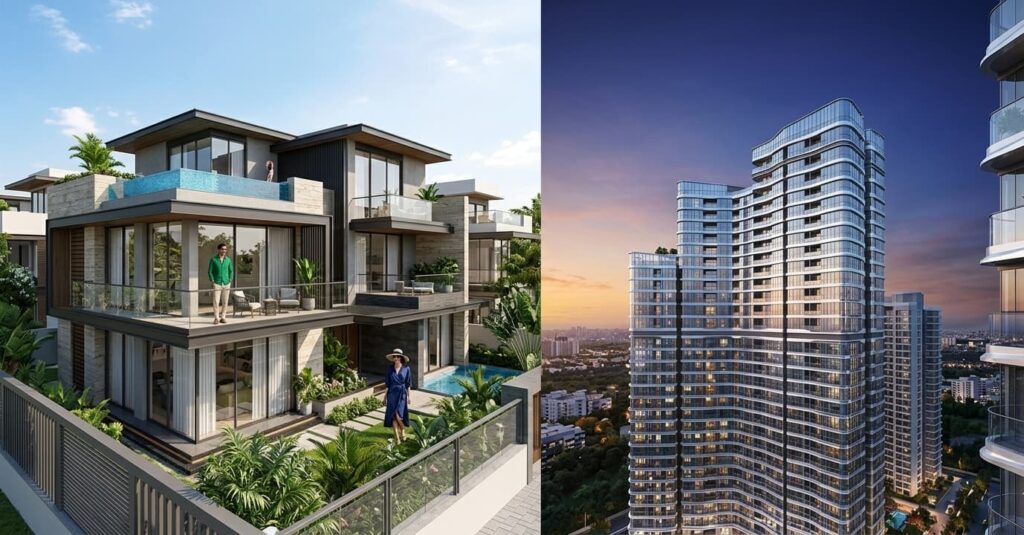
Quick Summary
Choosing between a duplex, a villa, and a flat requires understanding distinct ownership structures, spatial configurations, and financial commitments. A duplex offers two floors of single family living, a villa provides unmatched privacy on an independent plot, and a flat offers community living with shared amenities and low maintenance. This comprehensive guide details the architectural, economic, and practical differences to help you make an informed investment decision.
The choice of a home is one of the most significant decisions an individual or family will make. Modern real estate landscapes offer diverse housing formats, each designed to cater to specific living preferences, financial budgets, and lifestyle requirements. Among the most popular options available in urban and suburban markets today are duplexes, villas, and flats. While they all serve the primary purpose of providing shelter, they differ immensely in their architectural design, legal ownership structures, maintenance requirements, and privacy levels.
Understanding these variations is key to avoiding costly homebuying mistakes. A structure that works perfectly for a retired couple might prove restrictive for a growing multi-generational family, while a property layout suited for an investor looking for regular rental income may not satisfy someone seeking a customized personal sanctuary. This article provides an objective, highly detailed comparison of these three residential formats to clarify which option aligns best with your personal goals.
Understanding the Fundamentals: What Defines a Duplex, a Villa, and a Flat?
What is a duplex house?
A duplex is a single residential building that contains two distinct living units spread across two consecutive stories, connected internally by a staircase or lift. Unlike standard multi-story houses where different floors may be owned or occupied by unrelated tenants, a true duplex is legally classified as a single property and is typically designed for a single family. It features a unified kitchen, living area, and shared utility spaces, though the sleeping quarters are usually distributed across both levels.
In some markets, developers construct duplexes with separate entrance points for each floor, allowing two families to live independently under one roof. However, the architectural integrity remains cohesive. The physical design of a duplex emphasizes vertical space, often featuring high double-height ceilings in the main living room, which creates an open and airy atmosphere. It offers a practical middle ground for families who want the feel of an independent house without the steep financial commitment of purchasing a large plot of land.
What characterizes an independent villa?
A villa is an independent, detached residential structure built on a dedicated plot of land. Historically associated with country estates and upper-class retreats, modern urban villas represent premium, spacious properties located within high-end gated communities or exclusive residential pockets. A villa owner enjoys absolute ownership of both the built structure and the land it stands on, providing unparalleled freedom to customize, expand, or remodel the property within the boundaries of local municipal bylaws.
These properties are distinguished by their generous floor plans, private lawns, driveways, and personal terraces. Many luxury buyers choose to invest in independent homes with modern amenities, where they can design personal swimming pools, home theaters, and private gardens. Because villas are separate structures with zero shared walls, they offer a quiet, highly insulated lifestyle that is hard to replicate in more densely populated housing formats.
What constitutes a flat or apartment?
A flat, or apartment, is an individual housing unit located within a multi-story residential building. In this setup, the land on which the building is constructed is owned collectively by all the unit owners under an undivided share of land agreement. Individual buyers own the interior volume of their specific unit, while the structural shell, exterior walls, corridors, and common facilities are managed collectively by a housing society or a resident welfare association.
Flats are highly popular in major metropolitan areas because they make optimal use of expensive urban land. They offer residents immediate access to shared community infrastructure such as clubhouses, gyms, swimming pools, parks, and centralized security systems. The vertical nature of flat complexes allows developers to position these projects near commercial centers and transportation hubs, making them highly convenient for working professionals and small families who prioritize location over expansive personal space.
Structural Differences and Architectural Variations
Layout, configuration, and structural boundaries
The physical layout of these properties shapes the daily living experience. A flat is designed on a single horizontal plane. All rooms, including the kitchen, bathrooms, bedrooms, and balconies, are situated on one floor. This layout maximizes spatial efficiency and eliminates the need to climb stairs, which is an important consideration for families with toddlers or elderly members. The compact nature of flats also makes them easier to clean, heat, and cool.
Conversely, a duplex relies on a vertical layout. This structure naturally creates separate zones within the home. Typically, the ground floor is dedicated to public activities, housing the living room, kitchen, dining area, and guest rooms, while the upper floor is reserved for private family bedrooms and study spaces. This clear separation of public and private zones is highly valued by families who host guests frequently. Villas offer the most diverse layout options, ranging from single-story bungalows to multi-level estates with basements, attics, and external outhouses, providing a level of physical separation and spatial flexibility that other formats cannot match.
Shared walls versus independent plots
One of the most significant structural distinctions lies in the presence of shared walls. Flats are built with shared walls, ceilings, and floors. This means your home is physically connected to neighboring units on multiple sides, which can lead to acoustic challenges if the building material does not include adequate sound insulation. Minor issues like plumbing leaks in an upper unit can also impact the ceiling of the unit below, requiring coordination with neighbors for repairs.
A duplex may or may not have shared walls. Some duplexes are semi-detached, sharing a single partition wall with an adjacent duplex, while others are fully detached. However, the internal division between the two floors of a duplex is managed by a single family, avoiding multi-owner conflicts. Villas are entirely free from shared walls. Positioned in the middle of a private plot with standard setback areas on all sides, a villa ensures complete control over structural maintenance. If a villa owner wishes to repair their roof, paint their exterior, or install solar panels, they do not need to seek consensus from a building committee.
Privacy, Security, and Community Living
Privacy levels compared across all three types
Privacy is a major factor driving buyers toward premium housing options. Flats offer the lowest level of privacy because residents must navigate shared corridors, elevator lobbies, and parking decks daily. Balconies in high-rise buildings often overlook neighboring towers, and sound transmission through walls can sometimes limit personal privacy. For individuals who prefer a highly social, interactive lifestyle where neighbors are close by, this setup is often seen as a benefit rather than a drawback.
Duplexes offer a higher degree of privacy than flats, as there are no shared internal spaces with strangers. However, because they are often built in clustered layouts within urban developments, their yards and windows may still be visible to neighboring properties. Villas represent the absolute peak of residential privacy. With no shared walls, private gates, and dedicated outdoor spaces, villa residents can enjoy their gardens, terraces, and living areas away from the eyes and ears of neighbors, making it the preferred choice for those seeking a quiet, peaceful home life.
Gated communities and security systems
Security dynamics vary considerably between these three formats. High-rise flat complexes are generally recognized as the most secure housing option for urban residents. These projects feature professional, centralized security systems, including restricted entry gates, visitor management applications, continuous CCTV monitoring, and dedicated security personnel patrolling the premises. This structure makes it easy for residents to lock up their homes and travel for long periods without worrying about break-ins.
Independent villas historically required homeowners to set up and fund their own security measures, including high boundary walls, security cameras, and personal guard dogs. However, modern real estate trends have solved this problem through master-planned developments. Buyers can now find premium villas located within an exclusive residential community in Delhi NCR, which combines the complete physical independence of a luxury villa with the comprehensive, multi-layered security infrastructure of a modern gated township. Duplexes within gated communities benefit from similar setups, offering a balanced combination of security and personal independence.
Financial Analysis: Initial Costs, Maintenance, and Resale Value
Purchase price and transaction taxes
The initial cost of acquisition is usually the primary filter for homebuyers. Flats are the most financially accessible option. Because the land cost is divided among hundreds of residents, developers can price flats competitively, making them ideal for first-time buyers. Duplexes represent a mid-tier financial commitment, costing more than a standard flat of similar square footage due to the two-level construction and lower density of the building, but remaining more affordable than a standalone villa.
Villas are premium real estate assets and command the highest prices. The buyer is not only purchasing a large built-up area but also acquiring outright ownership of a piece of land, which is a finite and valuable resource. When making these large investments, it is vital to understand the complete financial picture. Buyers should thoroughly read our real estate transaction terms to understand additional costs such as stamp duty, registration charges, local development taxes, and club membership fees, which can vary significantly depending on whether you are purchasing an individual flat or a premium independent villa.
Long term maintenance and operational expenses
Owning a home involves ongoing operational costs that can impact long-term financial stability. In a flat complex, maintenance is managed by a centralized committee. Every owner pays a fixed monthly or quarterly fee, which is calculated based on the square footage of their unit. This collective fund covers elevator servicing, security staff salaries, generator fuel, and the cleaning of common areas. This shared financial responsibility keeps individual costs predictable and manageable.
Villa owners, in contrast, bear the sole responsibility for all maintenance and repair costs. If the roof develops a leak, the exterior paint fades, or the private garden requires landscaping, the owner must hire contractors and cover the entire cost out of pocket. Duplex maintenance sits in the middle; if the duplex is part of a planned housing society, some external and structural upkeep may be covered by a shared maintenance fund, but the owner remains fully responsible for all internal repairs and utilities across both floors.
Resale value and return on investment (ROI)
From an investment standpoint, the rate of property appreciation is directly tied to land ownership. Land appreciates over time, while constructed buildings gradually depreciate due to wear and tear. Because villa owners hold complete legal title to the land, villas generally experience higher long-term capital appreciation compared to flats. This makes villas excellent vehicles for long-term wealth preservation and growth.
Flats, while appreciating at a slower rate due to the minimal undivided land share allocated to each owner, offer superior market liquidity and rental yields. It is much easier to find a tenant for a mid-sized flat in a well-connected area than it is to rent out a premium, expensive villa. Similarly, selling a flat is generally quicker because the buyer pool for affordable and mid-range apartments is significantly larger than the niche market for high-value villas and duplexes.
Comparative Matrix: Duplex vs Villa vs Flat
To help visualize the key differences between these three housing types, the table below highlights the critical performance and cost metrics of each format:
| Feature | Duplex | Villa | Flat |
|---|---|---|---|
| Floor Count | Exactly two floors | Single or multi-story | Single floor (typically) |
| Land Ownership | Shared or individual plot | Complete individual ownership | Undivided share of land (UDS) |
| Customization | Moderate (limited to interiors) | High (interiors & exteriors) | Low (interior modifications only) |
| Privacy Level | Medium to High | Maximum | Low to Medium |
| Maintenance Costs | Medium | High | Low (shared collectively) |
| Security Infrastructure | Depends on project setting | Private or community gated | Centralized 24/7 security |
| Appreciation Potential | Moderate to High | High (tied to land value) | Moderate |
Lifestyle Fit: Which Housing Type Suits Your Needs?
Best options for growing families and multi-generational households
For large families where multiple generations live together, space and privacy are vital. A duplex is often a great choice for this lifestyle because the vertical separation allows grandparents to reside comfortably on the ground level, avoiding the need to climb stairs, while the younger generation utilizes the upper floor as their private retreat. This configuration supports family unity while respecting individual daily schedules.
Villas offer an even more spacious option for large families. With private yards for children to play, separate parking spaces for multiple vehicles, and ample room to host family gatherings, villas provide a grand and unrestricted lifestyle. The absence of immediate neighbors means family celebrations, children playing, and late-night gatherings can take place without causing any disturbance to others, offering a relaxed environment for everyone.
Best options for busy professionals and retirees
For young professionals, corporate executives, and empty-nesters, the convenience and ease of maintenance offered by flats are hard to match. Professionals who travel frequently for work appreciate the secure, lock-and-leave environment of a modern apartment complex. They do not have to worry about watering a lawn, fixing roof tiles, or managing security guards while they are away.
For retirees, a flat offers a supportive community environment where medical facilities, parks, and daily conveniences are located close by. The active social life within apartment complexes helps prevent feelings of isolation, and the presence of maintenance staff ensures that minor household issues are addressed quickly without physical strain on the resident. Heritage Prime observes that urban markets continue to show high demand for premium flats due to this seamless blend of convenience, security, and community engagement.
Regulatory compliances and buyer protection
Regardless of the housing type you choose, verifying regulatory compliance and ensuring legal safety is a critical part of the buying process. Buyers must ensure that the project is registered under the Real Estate Regulatory Authority (RERA) and has secured all necessary environmental, fire safety, and municipal clearances. This protects your financial investment from project delays or structural legal issues.
Additionally, modern real estate transactions involve sharing sensitive personal and financial data. When coordinating with developers, banks, and legal advisors, buyers should work with organizations that adhere to our customer data privacy policy. This ensures that your financial records, identity documents, and personal contact details are managed securely, keeping your entire transaction private and protected from unauthorized access.
Frequently Asked Questions
Can a duplex be converted into two separate apartments?
Yes, a duplex can sometimes be converted into two separate units, but this depends on its architectural design and local building regulations. If the duplex has separate entrances for each floor and independent utility connections, conversion is physically straightforward. However, you must obtain formal approval from the local municipal authority to update the property tax records, utility meters, and structural titles from a single residential unit into two independent apartments.
Who is responsible for maintaining the external facade of a flat compared to a villa?
In a flat complex, the Resident Welfare Association or housing society is responsible for all external structural maintenance, including painting the facade, repairing outer walls, and waterproofing the main roof. This is funded through collective maintenance fees. In contrast, a villa owner has sole responsibility for the external facade. Any repairs, painting, or structural upkeep of a villa must be planned and funded entirely by the individual owner.
Do villas always have higher appreciation rates than duplexes and flats?
Generally, villas experience higher capital appreciation because they include outright ownership of the underlying land. Land values tend to increase over time due to scarcity, especially in growing urban areas. Flats appreciate at a more moderate rate because the built structure depreciates as it ages, and buyers own only a small undivided share of the land. However, a well-located flat in a prime city center can sometimes outperform a poorly connected suburban villa in the short term.
What are the primary legal differences in ownership deeds for flats and villas?
When you purchase a villa, you receive a sale deed for the built structure along with a clear title deed for the specific plot of land. This gives you absolute ownership of both. When you purchase a flat, you receive a sale deed for the built-up area of your apartment, along with an undivided share (UDS) in the land on which the entire building stands. This means you own the land jointly with all other flat owners in the building, and no single resident has exclusive rights to any specific part of the ground space.