
Quick Summary
Buying a 2BHK villa in Greater Noida under 40 Lakhs is theoretically possible but comes with significant trade-offs regarding location, legal status, and infrastructure. Most options in this budget are located in peripheral, semi-urban zones, lack official development authority approval, and are built on freehold or abadi land. Buyers must perform rigorous legal due diligence to avoid structural hazards and regulatory issues.
The Reality of Budget Villas in Greater Noida
The dream of owning an independent home with private roof rights drives thousands of buyers toward the outer fringes of the National Capital Region. When searching for a 2BHK villa in Greater Noida under the 40 Lakh threshold, the market presents a complex landscape of opportunities and warnings. While the headline price is highly appealing, the physical reality of what you receive requires careful evaluation.
Is a 40 Lakh budget realistic for an independent villa?
In the highly developed sectors of Greater Noida, such as Alpha, Beta, Gamma, Chi, or Phi, standard independent plots of 120 square meters to 200 square meters command prices that easily exceed 1.5 Crores. Consequently, finding a fully constructed 2BHK villa in these sectors for under 40 Lakhs is structurally impossible. The land value alone in these master-planned sectors far exceeds the entire budget. However, when we look beyond the municipal limits of the Greater Noida Industrial Development Authority (GNIDA), the pricing dynamics shift dramatically.
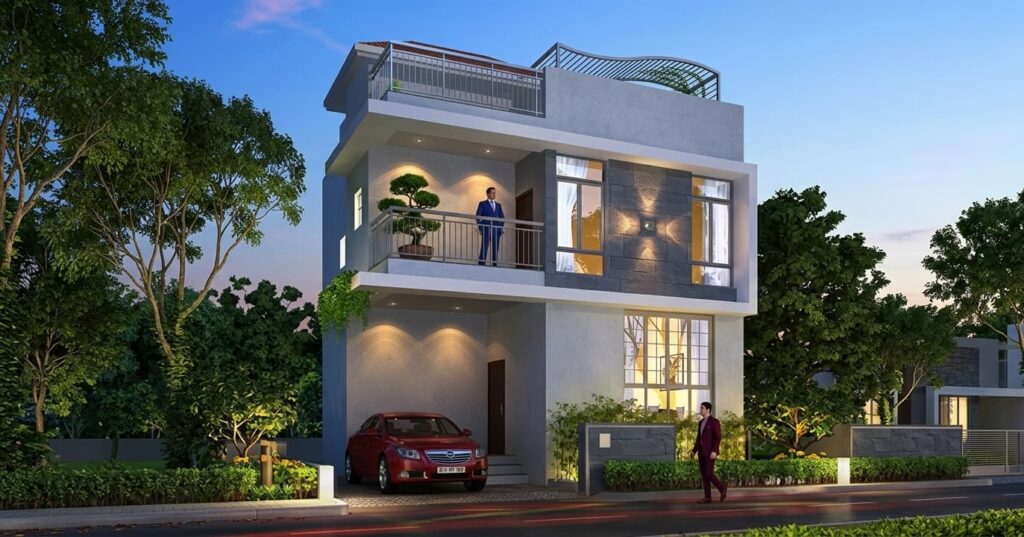
Villas marketed in the 30 to 40 Lakh bracket are generally built on freehold land, often classified as village abadi land or agricultural land that has been partitioned by private local developers. These properties are typically small, single-story or double-story independent structures built on plot sizes ranging from 50 square yards to 90 square yards. While developers use the term villa to attract interest, these structures are functionally independent builder floors or small row houses built closely together without the expansive lawns or premium clubhouses associated with classic luxury developments.
What structural configurations can you expect for 40 Lakhs?
A typical 2BHK budget villa in this price range offers a compact living experience. The ground coverage is usually limited, with a carpet area of approximately 600 to 800 square feet. The layout generally includes a small front parking space suitable for a hatchback or two-wheelers, a tiny living room, two bedrooms, one or two bathrooms, and a semi-modular kitchen. The structure is often designed to support future expansion, allowing owners to add a first floor when their financial situation improves. However, the quality of construction materials, foundation strength, and architectural planning are frequently compromised to keep the initial retail price low.
Micro-Markets for Budget Villas in Greater Noida
To find independent housing at this low price point, buyers must look at specific geographical pockets. These areas sit on the boundary lines between rural farmland and urban development, offering lower land acquisition costs for developers.
Which sectors and localities offer these options?
The majority of these low-cost independent homes are concentrated in areas such as Lal Kuan, Chhapraula, Achheja, Badalpur, and the outer villages of Noida Extension (Greater Noida West) like Bisrakh and Chipiyana Buzurg. These localities are situated near major transit corridors like the National Highway 91 (GT Road) or the Taj Expressway links, but they lie outside the immediate development jurisdiction of GNIDA. This administrative difference is the primary reason why land prices here remain low enough to make a 40 Lakh villa commercially viable for local builders.
Another emerging pocket is the Dadri peripheral region, where agricultural land conversion has allowed local construction companies to build small gated clusters of 50 to 100 row houses. While these projects are marketed as gated societies with security gates and basic internal roads, they do not offer the wide, well-maintained arterial roads, underground drainage, and continuous green spaces found in the planned sectors of Greater Noida.
How does location affect daily living conditions?
Living in these peripheral micro-markets requires accepting several daily compromises. Road access is often narrow, with internal streets measuring only 15 to 20 feet wide, which can lead to traffic bottlenecks. Public transport infrastructure, such as direct metro connectivity, is typically several kilometers away, forcing residents to rely on shared auto-rickshaws or personal vehicles. Furthermore, municipal services like structured garbage disposal, storm water drainage, and public street lighting are often irregular or non-existent in these unregulated pockets.
Hidden Costs and Infrastructure Realities
The sticker price of 40 Lakhs is rarely the final cost of ownership. Buying an independent villa in an unapproved or semi-approved pocket carries several financial overheads that buyers must calculate before signing any agreements.
What are the true costs of ownership?
When purchasing these budget properties, the final cost can quickly escalate by 15% to 20% due to various hidden fees. The following table highlights the typical additional expenses associated with buying a budget villa in these peripheral zones:
| Expense Category | Approximate Cost | Impact on Budget |
|---|---|---|
| Stamp Duty & Registration | 5% to 7% of property value | Significant upfront cash required |
| Electricity Connection (Load allocation) | INR 30,000 to INR 50,000 | Mandatory for basic occupancy |
| Water Boring & Submersible Pump | INR 40,000 to INR 70,000 | Necessary due to lack of municipal supply |
| Internal Development Charges (IDC) | INR 1,00,000 to INR 2,000,000 | Often demanded by local builders |
| Society Maintenance Deposit | INR 20,000 to INR 50,000 | Charged for security and common lighting |
Additionally, buyers must be aware of the long-term cost of infrastructure. Since many of these communities are not connected to the city sewer lines, individual septic tanks must be cleaned regularly, adding a recurring cost and potential hygiene hazards if not managed correctly. Power supply is another major challenge, as these areas often face frequent power cuts, requiring investment in heavy-duty inverters or silent generator sets.
What are the water and sewage realities?
Unlike planned group housing projects, budget villas rarely have access to treated municipal water supply. Residents must rely on underground borewells, which can raise environmental and health concerns. The groundwater table in several peripheral parts of Greater Noida has high levels of dissolved solids, making it imperative to install high-quality reverse osmosis water purification systems. Similarly, the absence of public stormwater drains means that during heavy monsoon periods, these low-lying peripheral colonies are highly prone to waterlogging, which can weaken the foundations of budget-constructed buildings over time.
Legal and Regulatory Risks of Budget Villas
The single most important factor that buyers must consider before investing in a 2BHK villa under 40 Lakhs is the legal status of the land and the structure. In the real estate market of Delhi NCR, cheap properties are often directly linked to high regulatory risks.
Are these budget villas approved by GNIDA?
Almost all independent villas priced under 40 Lakhs in Greater Noida do not have GNIDA approval. This is because GNIDA does not auction or approve small plot layouts of 50 to 80 square yards to private builders for individual development. These properties are built on freehold land, which is often agricultural land that has not undergone the formal Change of Land Use (CLU) process. Because they lack these necessary regulatory approvals, these structures are technically classified as unauthorized constructions, making them vulnerable to demolition drives by local government authorities.
Furthermore, these properties are almost never registered under the Real Estate Regulatory Authority (RERA). RERA registration is mandatory for projects exceeding 500 square meters or containing more than eight apartments, but local builders bypass this by constructing individual units on small partitioned plots or registering them as individual, non-commercial structures. Buyers should carefully study the legal terms and service conditions of any property transaction in this segment to protect themselves from sudden legal disputes or structural demolition orders.
Can you get a home loan for a 40 Lakh villa?
Securing a home loan from nationalized public sector banks like State Bank of India, Bank of Baroda, or Punjab National Bank for an unauthorized freehold villa is nearly impossible. These financial institutions require clear title deeds, approved building maps, and proof of non-agricultural land status. If you require financial assistance, you will likely have to rely on small non-banking financial companies (NBFCs) or cooperative banks. These private lenders charge significantly higher interest rates, often 3% to 5% higher than the market standard, which can quickly erase the initial savings of a lower purchase price.
Comparing Budget Villas to Luxury Alternatives
When weighing the decision to buy an affordable independent house, it is helpful to contrast these structures with the broader regional real estate market. The desire for independent living often clashes with the safety, security, and long-term capital appreciation offered by planned communities.
How do budget villas compare to luxury alternatives?
While a budget villa offers immediate privacy and no maintenance bills from large developer associations, it lacks the overall security and amenities of premium residential properties. Modern residential developments are planned with earthquake-resistant structural designs, high-speed elevators, fire safety systems, dedicated power backups, and professional security teams. For home buyers seeking long-term security, investing in established, premium residential properties in Delhi NCR ensures peace of mind, proper legal safety, and robust capital growth over the years.
Furthermore, high-end gated developments provide community facilities like swimming pools, tennis courts, curated parks, and clubhouses that are simply impossible to find in a small 40 Lakh villa cluster. The difference in construction standards is also vast. Budget villas are often built using local masonry with limited structural supervision, whereas premium developments utilize advanced construction technologies like Mivan shuttering, ensuring long-term structural integrity and minimal dampness issues.
Is it better to buy a budget villa or a verified luxury community?
If your budget is strictly capped at 40 Lakhs, you must choose between a small, potentially risky independent villa in a peripheral zone or a modern multi-story apartment in a fully approved, RERA-compliant project. A 2BHK apartment in a gated township might offer less square footage of private roof space, but it provides secure living, legal safety, and access to bank finance.
For those who can stretch their budget or are looking for planned plotted developments that offer a blend of independence and luxury, projects like the Ayodhya Enclave luxury villa project present a far safer and more rewarding investment path. These developments combine the freedom of independent living with master-planned roads, uninterrupted power, and clean water infrastructure, proving that well-regulated communities are always a superior choice for family safety and wealth accumulation.
Critical Due Diligence Steps for Buyers
If you decide to move forward with purchasing a budget villa in Greater Noida, you must take strict steps to verify the property. Neglecting these details can result in a total loss of capital if the property is later declared illegal or becomes structurally unstable.
How to verify land titles and ownership history?
Before paying any booking amount, demand the complete chain of ownership documents. In freehold properties, the land is often sold multiple times to different buyers over decades. You must ensure that the current seller has a clear registered sale deed and that their name is updated in the local land revenue records, a process known as mutation (Dakhil-Kharij). A lack of land mutation is a major red flag indicating that the seller does not have full legal rights to transfer the property.
You should also hire an independent legal lawyer to conduct a search of the property title at the local sub-registrar’s office for the past 30 years. This search will confirm whether the land is free from any existing bank mortgages, family disputes, or government acquisition notices.
How to assess structural quality without a professional engineer?
Since budget builders rarely employ structural engineers, buyers must look for signs of structural compromise. Inspect the property during the day and check the thickness of the walls; external walls should be at least 9 inches thick to provide proper insulation and support. Look closely at the joints where the roof slab meets the brick walls to check for early signs of hair-line cracks or water leakage. Check the quality of the plumbing fixtures and electrical wiring, ensuring that the builder has used fire-resistant wires and durable pipes rather than cheap local substitutes.
To navigate these complex legal and physical evaluations, it is always wise to get in touch with our real estate consultants who can offer verified property options, clear title verifications, and professional guidance throughout the purchasing process.
Frequently Asked Questions
1. Can I get a registry for a villa under 40 Lakhs in Greater Noida?
Yes, registry (the execution of a sale deed at the sub-registrar office) is possible for freehold villas in certain pockets like Lal Kuan or Chhapraula. However, having a registered sale deed does not automatically mean the building map is approved by GNIDA. The registry only records the transfer of the land and structure, but does not legalize an unapproved building.
2. What is the difference between Authority-approved and Freehold villas?
Authority-approved villas are built on land allotted directly by GNIDA, featuring wide planned roads, municipal water, proper sewer systems, and eligibility for easy bank loans from top public sector banks. Freehold villas are built on private, non-allocated village land, lacking master-planned municipal infrastructure and carrying higher regulatory and legal risks.
3. Are there any monthly maintenance charges for these budget villas?
Yes, most of these budget villas are built in small gated clusters where local builders or resident welfare associations (RWAs) charge a small monthly fee, typically ranging from INR 500 to INR 1,500. This money is used to pay for private security guards, common street lighting, and regular cleaning of the shared internal colony lanes.
4. What is the average resale value of a 40 Lakh villa in Greater Noida?
The resale value of freehold budget villas grows much slower than that of approved luxury properties. Since these areas lack formal municipal infrastructure and suffer from poor legal clarity, future buyers are often hesitant, meaning these properties can take a long time to liquidate if you decide to sell in the future.