
Quick Summary
Securing an under-construction villa involves detailed checks to protect your financial interest. This exhaustive guide details methods to verify developer track records, legal titles, RERA registrations, surrounding master plans, and structural specifications to ensure a safe and smooth home buying experience.
Developer Track Record and Financial Health
How do you verify a builder’s past delivery record?
Evaluating a developer track record requires look-back analysis going beyond simple sales brochures. A prospective buyer must research past residential projects executed by the developer. It is important to inspect completed sites to observe the aging of construction, maintenance quality, and actual delivery timelines versus committed dates. Speaking directly with current residents of those older developments reveals practical realities regarding the builder post-sales support and structure quality. A pattern of consistent delays across multiple previous projects is a strong warning indicator that the under-construction villa could face similar issues.
Additionally, search online forums, legal databases, and consumer court filings for unresolved disputes or active litigation involving the builder. Analyzing these public records helps establish whether the developer has a history of arbitrary plan modifications, delivery failures, or unilateral contract alterations. Buyers must pay attention to how the developer handles customer grievances, as this reflects their long-term professionalism and commitment to client satisfaction.
What financial indicators show a developer’s stability?
A builder financial health directly dictates whether a construction project reaches completion on schedule. Many real estate projects experience severe delays because developers divert funds from one project to kickstart another, leading to a liquidity crunch. Buyers must inspect the financial statements of the development company, which are often available via the Ministry of Corporate Affairs portal or summarized in RERA filings. High debt-to-equity ratios and constant restructuring of corporate loans signal financial distress.
Another practical test of financial viability is the willingness of major public sector and private banks to fund the project. If leading financial institutions hesitate to approve home loans for a specific project, it suggests that the project has structural financial risks or title discrepancies. Conversely, pre-approved loan status from multiple tier-one banks indicates a higher level of institutional trust and a lower probability of insolvency during the construction cycle.
Legal Approvals and RERA Registration
Is the project registered under the State RERA authority?
Every under-construction real estate project exceeding five hundred square meters or comprising more than eight apartments or villas must be registered under the Real Estate Regulation and Development Act (RERA). RERA registration provides a shield for buyers, ensuring the developer adheres to the approved plans, timelines, and financial discipline. Buyers should visit the respective state RERA website, enter the unique registration number, and review all uploaded documents, including sanctioned plans, quarterly progress reports, and expected date of possession.
Investing in such assets requires regular review of the latest property market updates to understand shifting tax policies and regulatory changes. A registered RERA status means the developer is legally bound to deposit seventy percent of the collected funds into an escrow account dedicated solely to construction and land costs, which minimizes the risk of fund diversion. Buying a villa that lacks a valid RERA registration is extremely risky and can leave the buyer without legal recourse in case of a default.
What land title clearances are mandatory?
The land on which the villa is being constructed must have a clear, marketable title. A buyer must demand to see the title deed, verifying that the developer owns the land or has a valid, registered joint development agreement with the original landowner. An encumbrance certificate covering the past thirty years must be scrutinized to confirm that the land is free from active legal disputes, mortgages, or unpaid dues. This step prevents situations where third-party financial institutions assert claims over the property post-booking.
Buyers looking for premium residential properties in Delhi NCR should prioritize projects where the land ownership is clear and unencumbered. In addition to land title deeds, buyers must verify the non-agricultural land conversion order, building layout approvals from local municipal bodies, and clearance certificates from pollution control boards and aviation authorities. Ensure that the master layouts do not conflict with green zones or forest land, as such violations can lead to demolition orders later on.
Physical Site Verification and Surrounding Master Plan
Why is visiting the actual construction site necessary?
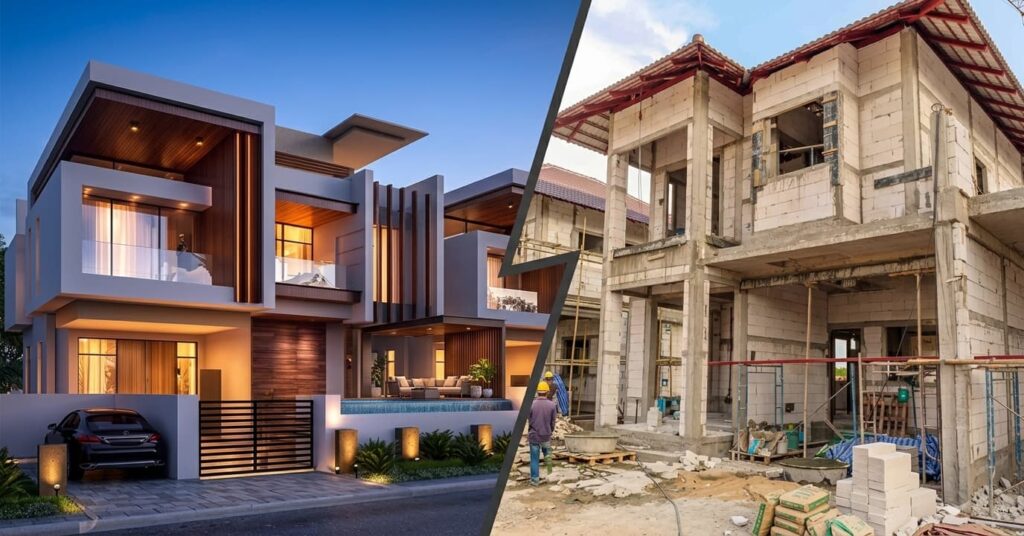
Relying solely on digital renders, miniature models, and glossy brochures is a common mistake. Visiting the actual site is indispensable for verifying the physical progress of the project and comparing it with the developer-asserted timelines. While on-site, observe the density of labor deployed, the activity level of machinery, and the presence of basic building materials. A silent construction site with minimal workforce activity is a primary indicator of potential project delays or underlying cash flow problems.
Additionally, physical visits allow you to inspect the layout orientation, natural light access, and the proximity of the villa plot to high-tension power lines, open drains, or industrial zones. It also helps check if the actual topography matches the marketing layout. For instance, a villa promised with a private garden might look different if the site has elevation differences that the sales team neglected to mention. Industry observations by market research teams at Heritage Prime show that high-end villa segments are increasingly scrutinized by legal experts before booking to prevent layout discrepancies.
How does the city master plan affect your future villa valuation?
An under-construction villa is a long-term asset, and its lifestyle value is highly dependent on the development of the surrounding neighborhood. Buyers must study the city development master plan to see what infrastructure projects are scheduled for the area. A planned metro extension, a new expressway, or a commercial office park will drive future capital appreciation. Conversely, a proposed industrial zone, waste treatment plant, or high-density low-income housing complex nearby could negatively impact the exclusivity and pricing of your villa.
Check the existing civic infrastructure, including road width, water supply lines, electricity grids, and storm-water drainage systems. If a villa development relies entirely on groundwater tankers or lacks a connection to the main sewer lines, it will create substantial operational issues once you move in. Evaluating the current state of local amenities like schools, medical facilities, and retail centers provides a clear picture of the neighborhood readiness for habitation.
Payment Plans, Hidden Costs, and Financial Agreements
Which payment structure protects buyers from project delays?
Developers offer various payment options to attract buyers, including down payment plans, construction-linked plans, and subvention schemes. The safest structure for a buyer is the construction-linked payment plan (CLP). Under a CLP, payments are strictly tied to the completion of specific construction milestones, such as foundation laying, structural slab casting, brickwork, and plastering. This system ensures that your funds are only released as physical progress is achieved on-site, reducing the developer incentive to stop work.
When signing the builder-buyer agreement, buyers must examine the legal terms and service conditions to prevent unfair penalty clauses. Down payment plans, while offering discounts, should be avoided for under-construction projects because they transfer the entire financial risk to the buyer. If the project stalls, recovering a complete upfront payment is incredibly difficult, whereas under a CLP, your exposure is limited to the actual stage of construction.
What are the common hidden charges in villa agreements?
The basic sale price of an under-construction villa is rarely the final cost of acquisition. Developers often add several supplementary charges that can inflate the total budget by fifteen to twenty-five percent. Buyers must demand a complete, itemized cost sheet before making a booking deposit. This prevents sudden financial demands during the later stages of construction.
Key hidden costs to watch out for include: external development charges, infrastructure development charges, club membership fees, advance maintenance deposits, electricity and water connection installation fees, and legal agreement drafting fees. It is also important to clarify the GST implications, stamp duty rates, and registration fees, as these statutory payments are paid on actual values at the time of property registration. Ensure that the agreement clearly states that no additional charges will be levied unless mutually agreed upon in writing.
| Payment Plan Type | Key Characteristics | Buyer Risk Profile | Financial Advantage |
|---|---|---|---|
| Construction-Linked Plan (CLP) | Payments tied directly to specific construction milestones. | Low – paid only on physical progress. | Saves interest cost; incentivizes timely completion. |
| Down Payment Plan | Almost ninety percent of cost paid upfront within a few months. | High – builder holds complete cash with no guarantee. | Offers a five to ten percent discount on basic cost. |
| Time-Linked Plan | Payments due at fixed calendar intervals regardless of progress. | Medium – risk if construction gets delayed. | Predictable financial planning for cash flows. |
Layout Approval, Floor Plans, and Loading Factor
How to distinguish between super built-up area and carpet area?
When booking a villa, developers often quote the price based on the super built-up area, which includes the actual usable space plus common areas like corridors, clubhouse shares, security cabins, and peripheral walls. However, the only metric that matters for daily living is the carpet area, defined as the net usable floor area of the villa, excluding the area covered by the external walls, service shafts, and common spaces. Under RERA guidelines, developers must disclose the exact carpet area of the villa and price the property accordingly.
Calculate the efficiency ratio of the layout by dividing the carpet area by the super built-up area. A higher percentage indicates a highly efficient floor plan with minimal wasted space on common corridors or structural voids. In villa developments, the loading factor should ideally be lower than in high-rise apartments because shared common facilities are spread across a larger ground layout. Ensure that the booking document specifies the exact dimensions of individual rooms, balconies, and private yards rather than relying on generalized approximations.
What specific changes in villa specifications are permissible?
Many buyers request layout customizations, such as merging rooms, converting a balcony into a study, or upgrading sanitary ware during the construction phase. It is critical to establish what changes are legally permissible and structurally safe. Major structural alterations involving load-bearing walls, column placements, or plumbing lines cannot be changed without written approval from structural engineers and the municipal authority. Unauthorized changes can weaken the building integrity and void the structural warranty provided by the builder.
For minor cosmetic upgrades, clarify if the builder will execute them directly or if they will allow third-party interior contractors on-site before the possession certificate is issued. If the builder agrees to complete customizations, get a detailed, signed addendum to the main agreement listing the modified specifications, the cost implications, and any changes to the final possession timeline caused by these custom modifications.
Specifications, Amenities, and Infrastructure Commitments
What building materials and structural standards should be verified?
The durability of a villa is determined by the quality of the raw materials used during the construction process. Buyers should request a detailed specification sheet that details the brands, grades, and types of materials allocated for structural concrete, steel reinforcement, plumbing pipes, electrical wiring, flooring tiles, and exterior paint. For high-end villa projects, details on waterproofing systems for roofs and basements are critical, as leakages are common issues in premium homes.
Ask the developer if they conduct regular quality audits and whether they can share the concrete compressive strength test certificates and soil analysis reports. The villa foundation must be designed to withstand local seismic activity zones, and the structural design must be approved by a registered architect. Confirming these technical standards ensures that the villa remains structurally sound over decades, preserving both its physical safety and its resell value.
Are the promised infrastructure facilities part of the final contract?
Luxury villa living is defined by the community infrastructure, such as dedicated water supply networks, underground electrical cabling, solar streetlights, fiber-optic connectivity, sewage treatment plants, and solid waste management systems. Often, developers highlight elaborate clubhouses, swimming pools, tennis courts, and landscaped parks in their promotional materials, but fail to include them in the official timeline of the builder-buyer agreement.
If there are doubts regarding the development schedule, it is wise to contact seasoned property experts who specialize in villa due diligence. Buyers must verify that all common amenities are explicitly listed in the sanctioned layout plan and that their delivery schedules coincide with the completion of the residential villas. A common risk is that the builder delivers the houses but delays the construction of the clubhouse or park for several years, leaving residents without access to the amenities they paid for.
Frequently Asked Questions (FAQ)
1. Can a developer change the sanctioned layout plan of a villa project without the buyer consent?
No. Under the RERA Act, a developer cannot make any major additions or alterations to the sanctioned plans, layout designs, or specifications of the villa project without the prior written consent of at least two-thirds of the allottees who have agreed to buy villas in that project. Minor structural modifications due to architectural exigencies may be allowed, but these must still comply with municipal guidelines and RERA notifications.
2. What happens if there is a delay in the delivery of the under-construction villa?
If the developer fails to deliver the villa by the date agreed upon in the builder-buyer contract, the buyer has two options under RERA. They can choose to withdraw from the project and demand a full refund of the amount paid along with interest at the prescribed rate. Alternatively, if the buyer wishes to remain in the project, they are entitled to receive monthly compensation interest from the developer for every month of delay until possession is delivered.
3. Should I buy a villa in a project with pre-approved loans from only one bank?
It is highly recommended to select projects that have approval from multiple leading banks. When multiple financial institutions conduct legal and technical evaluations of a project, it increases the likelihood that the land title is clear and that all municipal approvals are authentic. A single-bank approval might indicate a restrictive arrangement, which could limit your financing choices and increase the risk of undetected title flaws.
4. How is the possession date calculated, and is there a grace period for developers?
The possession date must be clearly defined in the registered builder-buyer agreement as a specific month and year. Many contracts include a force majeure clause allowing a grace period of three to six months for unforeseen events, such as natural disasters or government-mandated construction halts. However, this grace period cannot be invoked arbitrarily by the developer for routine supply shortages, labor strikes, or financial difficulties.