
Quick Summary
This comprehensive comparative analysis examines why premium end-users increasingly favor independent villas over high-rise apartments. Key structural, financial, and psychological factors are analyzed, highlighting how absolute land ownership, structural autonomy, and acoustic privacy offer superior long-term satisfaction compared to vertical community housing.
Urban layouts in metropolitan regions have historically expanded upward due to rapid population growth and land limitations. High-rise developments dominated the residential sector for many decades, presenting integrated communities, standard facilities, and managed upkeep. However, a significant structural shift is underway in the premium residential sector. End-users, who buy homes to live in rather than for short-term speculation, are showing a distinct preference for horizontal developments over high-density vertical projects.
This shift is not merely a brief design trend; it represents a deeper change in how modern families view comfort, personal space, and asset security. The day-to-day experience of living in crowded high-rise towers, with shared utilities, elevator dependency, and close proximity to neighboring homes, has led many to re-evaluate their long-term housing choices. As a result, premium horizontal communities are seeing a strong rise in interest. This development is reshaping real estate planning, particularly in expanding suburban zones where land availability allows for spacious low-rise estates.
The Psychology of Space and Autonomy in Modern Housing
The layout of a residential property has a direct impact on the psychological well-being of its occupants. High-rise apartments, despite high-end interior finishes, restrict residents to pre-defined layouts that cannot expand. This horizontal boundary often creates a feeling of confinement. In contrast, an independent home offers multi-level living where different floors can be organized for specific needs, allowing multi-generational households to live together comfortably while maintaining personal space.
Why is personal space driving the shift away from high-rises?
Having a personal plot of land eliminates the feeling of being stacked in a vertical grid. The visual relief of looking out onto a private yard, garden, or quiet courtyard instead of another concrete tower helps reduce daily stress. For professionals who spend their workdays in structured office spaces or digital environments, returning to a home with high ceilings, private open space, and unobstructed sky views is restorative. This sense of openness is difficult to find in vertical apartments, where balconies remain exposed to high wind speeds, dust, and neighboring apartments.
How does the freedom to customize structural layouts affect buying decisions?
One major drawback of high-rise living is the rigid, unalterable floor plan. Apartment owners are bound by load-bearing columns, shear walls, and collective plumbing setups, making physical structural modifications nearly impossible. Buyers who choose independent homes with modern amenities enjoy complete freedom to modify layouts as their family needs evolve over time. If a household requires a new home office, a spacious utility room, or a private recreational area, the adaptable nature of an independent home allows for these adjustments without structural complications.
This adaptability also applies to personal architectural expression. Homeowners can introduce custom features such as skylights, double-height ceilings, internal home lifts, or customized basement areas. Vertical apartments force buyers to adapt their daily routines to the static layout designed by the developer. Over time, this restriction becomes a major point of friction for growing families who need flexible living spaces. Collaborative planning with professionals who understand this need for flexibility helps secure a property that accommodates future expansions safely.
Financial Dynamics: Appreciation, Land Ownership, and Long-Term Value
From a financial perspective, real estate value is fundamentally tied to land. In any property investment, the physical building depreciates over time, while the land underneath it appreciates. High-rise apartment buyers only own an undivided share of land (UDS), which is shared among hundreds or thousands of co-owners. This individual share is often very small, meaning the value of the investment is heavily dependent on the concrete structure, which deteriorates over thirty to forty years.
Do villas offer better long-term capital appreciation than high-rise apartments?
Conversely, villa owners hold sole title to the physical land parcel on which their home is built. This setup makes villas a highly effective wealth preservation tool. While the building material depreciates, the land value grows steadily, especially in planned suburban areas. Historical market data shows that land-based properties in developing suburban corridors appreciate at a rate that consistently outperforms vertical residential units, making them highly attractive to long-term end-users who view their home as an asset for future generations.
What are the structural depreciation factors of vertical developments?
High-rise buildings require complex, continuous maintenance of shared infrastructure, including water filtration units, high-speed elevators, fire suppression systems, and structural joints. As a high-rise ages beyond fifteen to twenty years, these communal elements require major capital upgrades, which often lead to disputes among apartment owners regarding funding. The physical exterior of a tower can degrade quickly due to weather exposure, lowering the overall aesthetic and market value of the building.
Villas do not suffer from this collective degradation vulnerability. The homeowner retains complete control over maintenance schedules, quality of materials used for waterproofing, and structural repairs. This independence ensures that the physical asset remains well-maintained, sustaining its market appeal far longer than an apartment building that relies on the consensus of a home owners association. For those evaluating purchase documentation, understanding the legal terms and service conditions associated with communal upkeep is highly recommended before finalizing any deal.
Privacy and Acoustic Comfort: Escaping the Shared-Wall Dilemma
Acoustic comfort is frequently cited as a major concern by those moving out of vertical apartments. In high-rise communities, apartments share walls, ceilings, and floors with adjacent units. The transmission of low-frequency sounds, such as footsteps from the floor above, children playing, televisions, or plumbing noise through shared shafts, is a persistent challenge. Despite advanced insulation materials, complete acoustic isolation is rarely achieved in standard apartment construction.
How do shared-wall structures affect acoustic privacy?
Villas resolve this issue by eliminating shared-wall configurations. With independent boundaries and setbacks on all sides, residents enjoy a quiet living environment. This spatial separation prevents internal household sounds from bothering neighbors and shields the family from external disturbances, allowing for a peaceful work-from-home setup or undisturbed rest. Professional developments, such as those represented by Heritage Prime, showcase how horizontal separation improves the quality of daily domestic life.
What lifestyle advantages do independent plots offer for growing families?
For families with young children or elderly members, independent plots offer exceptional freedom. Children can play in private yards or terrace areas without generating complaints from neighbors living below. Pet owners also benefit greatly, as villas eliminate the complications of shared elevator rides and strict building rules regarding pets. The absence of close-proximity neighbors allows families to host gatherings, social events, or quiet family dinners without worrying about privacy violations or noise complaints, cultivating a more relaxed home environment.
Outdoor Living, Custom Landscaping, and Health Benefits
High-rise communities often boast central parks, but these spaces are shared among hundreds of families. This shared usage can lead to overcrowding, restricted hours, and a lack of privacy. A villa owner has the luxury of cultivating a private garden, lawn, or kitchen garden. This private green patch offers a direct connection to nature, allowing residents to create personalized outdoor spaces, select their choice of plants, and enjoy outdoor leisure in complete seclusion.
Why is private green space preferred over communal parks?
A private garden provides a secure, clean environment where family members can relax without the social pressure of public spaces. It allows for personalized additions like a private plunge pool, a barbecue deck, or a children play area. This level of personalization turns the outdoor area into a functional extension of the home, promoting healthier lifestyles and more time spent outdoors.
How do independent terraces contribute to psychological well-being?
An independent terrace is one of the most valuable assets of a villa. Unlike apartment balconies, which are often small and overlooked by other floors, a private terrace is open to the sky. It provides a versatile space that can be transformed into an outdoor gym, a yoga deck, an open-air dining area, or a rooftop garden. Having access to clean air, direct sunlight, and open skies without leaving the home has a measurably positive effect on mental health and overall well-being, providing a personal retreat from hectic urban routines.
A Comparative Analysis of Cost, Governance, and Control
Let us evaluate how these two housing formats compare across key operational and structural parameters:
| Parameter | Independent Villa | High-Rise Apartment |
|---|---|---|
| Land Ownership | Full ownership of the plot | Undivided share of land (UDS) |
| Structural Autonomy | Complete freedom to modify | Highly restricted layouts |
| Acoustic Privacy | Excellent (no shared walls) | Moderate to poor (shared walls) |
| Long-term Value | High capital appreciation | Steady depreciation of structures |
| Custom Open Spaces | Private lawns and open terraces | Small balconies, shared parks |
How do community maintenance charges and association rules compare?
High-rise living involves dealing with strict apartment owners associations, which govern everything from parking rules to pet ownership and interior renovations. These rules can sometimes feel overly restrictive to homeowners who want complete control over their living environment. Furthermore, high-rise monthly maintenance charges can be high, often covering amenities that an individual resident may rarely use, such as massive central clubhouse operations or extensive elevator maintenance.
While villa estates also have maintenance fees for common infrastructure, the individual is not bound by rigid rules regarding their private structure. The governance is far more balanced, allowing for personal liberty while maintaining external aesthetics. This freedom makes horizontal properties highly appealing to individuals who prefer autonomy over structured, highly regulated communal living.
Gated Villa Communities vs Standalone Villas: Finding the Perfect Balance
One of the traditional arguments in favor of high-rise living has been safety. Tall apartment buildings feature multi-layered security, automated access points, and dedicated concierge teams. However, modern horizontal developments have bridged this gap through master-planned layouts. Today, gated communities offer similar, if not superior, security structures, featuring perimeter fencing, CCTV surveillance, automated visitor management, and patrolling guards.
What security features make modern villa estates competitive with luxury high-rises?
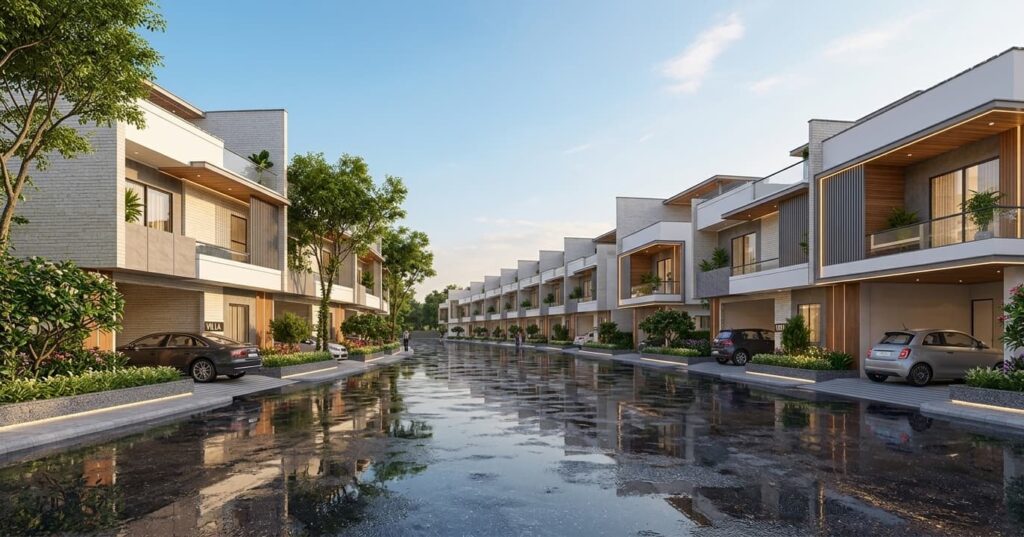
Living in the Palm Villas Noida gated community provides residents with the security of a luxury high-rise alongside the freedom of an independent home. This combination offers a highly secure environment where children can play safely on open streets, and families can enjoy absolute peace of mind without sacrificing their privacy.
How do developers solve the infrastructure challenge in premium villa layouts?
Historically, standalone villas were often built on isolated plots, meaning residents had to manage their own water supply, electricity backups, and road maintenance. Modern developers have resolved this issue by creating master-planned horizontal estates. These layouts feature wide roads, underground utility cabling, integrated rainwater harvesting, dedicated sewage treatment plants, and 100 percent power backup systems.
By choosing properties from a reputable real estate developer in NCR, buyers can secure a home that benefits from meticulously planned infrastructural planning. This ensures that residents enjoy the premium benefits of independent living alongside reliable, high-quality public utilities, eliminating the traditional maintenance headaches associated with legacy individual homes.
The Evolution of Smart Homes and Multi-Generational Living
The spacious layout of modern villas allows for comprehensive integration of home automation systems. Unlike apartments where automation is often limited to lighting and voice assistants, large-scale villas can implement sophisticated energy-efficiency grids, central climate control, automated irrigation for private lawns, and multi-zone security systems. The physical space allows for technical rooms, server racks, and centralized controls, transforming the home into a self-sustaining ecosystem.
Why are multi-generational families choosing horizontal designs over vertical apartments?
Multi-generational living is a deep-seated preference in many cultures. Having multiple generations under one roof requires an architectural design that accommodates varying daily schedules, noise levels, and privacy needs. A vertical apartment, even with four or five bedrooms, forces all occupants to live on a single level, leading to inevitable space conflicts.
Villas solve this by distributing rooms across multiple floors. Elderly family members can occupy the ground level for ease of access without stairs, while younger family members use the upper levels. This division of levels provides natural boundaries that support harmonious family dynamics. It allows members to gather in expansive common areas like ground-floor living rooms or rooftop decks, while retaining the option to retreat to their own completely quiet personal spaces when needed.
Frequently Asked Questions
Are maintenance costs for villas significantly higher than high-rise apartments?
While the overall absolute maintenance cost of a villa can be higher due to the sheer size of the property, it often represents better value. In high-rises, you pay a flat per-square-foot rate that funds extensive shared amenities you might not use. With a villa, you retain control over your physical upkeep budget, spending on direct structural improvements rather than administrative or collective high-rise overheads.
Is security a concern in villa communities compared to vertical residential complexes?
Modern master-planned villa estates feature highly sophisticated security infrastructure that matches or exceeds luxury apartments. This includes multi-tier entry verification, perimeter surveillance, patrolling staff, and smart home integration. This allows residents to enjoy the independence of a personal plot with the safety of a guarded gated community.
How does the resale liquidity of a villa compare to a luxury apartment?
Historically, premium independent villas retain their value much better because the land appreciates while the apartment building depreciates. While high-rise apartments might have quicker transactional velocity in the short term, villas attract highly qualified, serious buyers in the medium to long term, ensuring high-value returns.
Can I customize the external architecture of my villa in a gated township?
In most premium gated layouts, buyers can customize their interiors and structural plans entirely. However, to maintain the aesthetic harmony of the overall community, some estates suggest following broad architectural guidelines for the exterior facade. This balance protects the overall visual appeal and resale value of the entire residential development over time.