
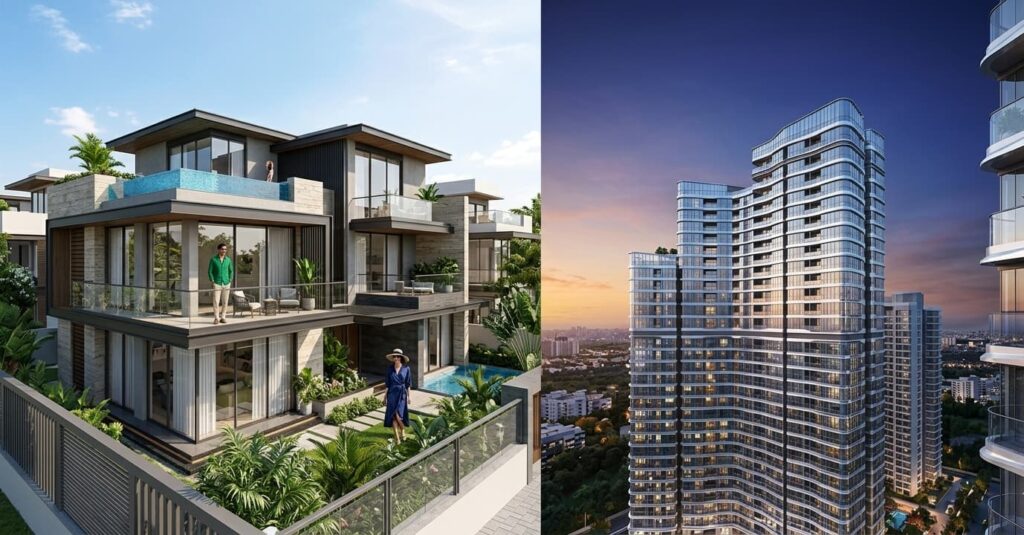
Quick Summary
Deciding between a residential plot and a flat in Greater Noida West depends on your investment horizon, desire for customization, and cash flow requirements. Plots offer superior long-term capital appreciation, absolute ownership, and the freedom to construct custom structures, but require higher upfront capital and active oversight. Apartments provide immediate occupancy, structured security, modern amenities, and easier financing, making them highly suitable for end-users and passive investors. This comprehensive guide details the financial, legal, and lifestyle implications of both property types to help you make an informed decision in one of India’s fastest-growing real estate hubs.
The Evolving Real Estate Landscape of Greater Noida West
Why is Greater Noida West attracting property buyers right now?
Greater Noida West, widely known as Noida Extension, has emerged as a major powerhouse of the National Capital Region real estate market. Its close proximity to central Noida, connectivity through major expressways, and upcoming infrastructure projects have made it a preferred choice for residential expansion. In recent years, the region has transformed from a developing suburb into a highly populated urban center. The expansion of the Aqua Line metro network, widening of the main connecting roads, and development of organized retail spaces have accelerated this progress.
Property buyers face a persistent dilemma when evaluating this market: whether to purchase an independent residential plot or to invest in a multi-story apartment. This choice is not merely financial but fundamentally alters your lifestyle, long-term wealth accumulation, and asset management style. Understanding the macroeconomic factors that drive this specific market is important to determine which vehicle aligns with your personal goals.
What is driving the shift between high-rise apartments and land parcels?
Market dynamics show that land parcels in Greater Noida West are increasingly scarce. While the initial phases of development focused primarily on high-rise residential towers to accommodate density, the demand for low-density housing has risen sharply. The local authorities have planned various sectors specifically for plotted developments, creating a highly competitive market where buyers seek long-term capital preservation.
In Greater Noida West, the distribution of plots and flats is highly structured. Sectors such as Sector 10, Sector 12, and the surrounding areas are primarily reserved for low-density developments, including planned authority plots and private township projects. On the other hand, areas such as Sector 1, Sector 4, and Sector 16B are dominated by massive high-rise residential complexes. This clear zoning means that your choice of property also dictates your exact neighborhood, surrounding infrastructure, and proximity to major commercial zones.
How does infrastructural development affect both investment types?
Road expansions, commercial retail sectors, public schools, and healthcare facilities are boosting property values across the board. According to market observations by Heritage Prime, land values in planned sectors have seen consistent upward trends, often outperforming the growth rate of high-rise apartments in the same vicinity. As new transit corridors open, both plots and flats enjoy value boosts, but the limited supply of land ensures that plots capture a higher percentage of the location premium.
Comparative Analysis: Plot vs Flat Investment Metrics
Which property type offers better capital appreciation?
When measuring capital appreciation, historical data from Delhi NCR indicates a distinct difference between land and built apartments. Land is a finite asset; its supply cannot be expanded. Consequently, as infrastructure improves, the land price rises exponentially. Apartments, on the other hand, are subject to structural depreciation. While the overall property value of an apartment might rise due to location appreciation, the actual concrete structure loses value over time, requiring periodic maintenance and renovations.
Analyzing the financial math further reveals that the cost of land acquisition has grown by over 100 percent in specific pockets of Greater Noida West over the last five years. High-rise apartments in the same sectors have also seen healthy price growth, but their appreciation is heavily tied to the maintenance and reputation of the developer. An poorly maintained apartment building can see stagnant prices even in a rising market, whereas a plot of land maintains its value simply due to its location and scarcity.
How do immediate rental yields compare between apartments and empty land?
In terms of immediate cash flow, apartments holding ready-to-move status hold a clear advantage. They can be immediately leased out to working professionals or families, generating monthly rental income. Plots, unless built upon, generate zero immediate yield and require holding costs such as annual property taxes. Therefore, investors seeking regular monthly cash flow usually find flats more aligned with their near-term financial requirements.
What are the differences in liquidity and exit strategies?
Liquidity is another differentiator. Selling an apartment in Greater Noida West is generally faster because the ticket size is lower and the market for buyers looking for immediate housing is larger. Plots, especially larger sizes, demand a higher overall investment once you account for both land purchase and construction costs. However, during market upswings, plots attract premium buyers looking for exclusive, custom-built estates, often yielding much higher profit margins upon eventual sale.
| Feature | Residential Plots | Multi-story Flats |
|---|---|---|
| Appreciation Potential | High (Land values appreciate exponentially over time) | Moderate (Subject to structural depreciation) |
| Rental Yield | Negligible (Requires construction to yield rent) | Steady (Immediate income from tenant occupation) |
| Initial Capital Required | Higher (Higher down payment, limited loan limits) | Moderate (Easy access to high-LTV home loans) |
| Possession Timeline | Immediate (For land) plus construction time | Immediate (Ready-to-move) or 2-4 years (Under-construction) |
Customization, Control, and Construction Freedom
Can you design a custom home on a residential plot?
The psychological satisfaction of owning land and having complete authority over its design is a primary driver for many property buyers. When you purchase a flat, you are confined to the layout, room dimensions, and material choices decided by the developer. Modifying the structural layout of an apartment is rarely permitted due to building load safety standards, leaving owners with limited options for personalization.
Conversely, a residential plot gives you a blank canvas. You can determine the number of rooms, select premium building materials, integrate sustainable energy features like solar panel arrays, and design private landscaped gardens. Many discerning buyers prefer constructing independent homes with modern amenities to perfectly suit their unique family dynamics. This flexibility allows for multi-generational living, where different floors can be allocated to children or relatives while retaining privacy.
What are the construction guidelines and local authority bylaws in Noida Extension?
Constructing your own home requires understanding the regional regulatory landscape. The Greater Noida Industrial Development Authority (GNIDA) has strict guidelines regarding Floor Area Ratio (FAR), permissible building heights, front and rear setbacks, and structural safety codes. Navigating these rules requires professional architects and verified contractors to avoid penalties. Failure to comply with these local authority guidelines can result in delays in getting completion certificates or even legal action.
How does a gated community plot compare to standalone land?
The environment surrounding the plot plays a major role in its long-term viability. Standalone plots in unorganized colonies often suffer from poor road connectivity, lack of streetlighting, and security risks. Purchasing land within an exclusive residential community in Delhi NCR ensures that your asset is protected from illegal encroachment while providing access to asphalt roads, regular water supply, and electricity grids. This middle ground provides the security of a master-planned community along with the freedom of independent construction.
Cost Breakdown: Initial Capital, Financing, and Maintenance
Is it easier to secure a home loan for a plot or an apartment?
The financial structure of buying land differs significantly from purchasing an apartment. When buying a flat, banks are highly eager to extend home loans covering up to 85 percent of the property cost, depending on the applicant’s credit profile. The repayment options are flexible, and the documentation process is largely standardized, especially with reputed builders.
For plot buyers, securing finance is slightly more complex. Land loans or plot purchase loans generally have lower Loan-to-Value (LTV) ratios, meaning the buyer must arrange 30 to 40 percent of the plot cost as a down payment. Furthermore, banks often mandate that the construction on the plot must begin within a specific timeline, usually two to three years from the loan disbursal date. This requires careful cash flow planning to ensure you have enough capital for both purchasing the land and executing the actual construction.
What hidden charges should buyers watch out for in both segments?
Hidden charges are another critical area where costs can escalate. For both options, you must account for stamp duty and registration fees. However, flat buyers must pay GST if the project is under construction, along with compulsory charges like power backup installation, club membership fees, and advanced maintenance deposits. To avoid hidden costs, buyers should study the legal terms and service conditions of their allotment agreements carefully before committing any capital. On the other hand, plot buyers face development charges levied by the local authority, boundary wall costs, and architectural approval fees.
How do maintenance costs affect your long-term return on investment?
Holding costs are significantly lower for plots. A vacant plot does not attract high monthly maintenance charges, which can be a substantial recurring expense in premium apartment complexes. This makes plots an attractive option for long-term investors who want to park their capital without worrying about monthly cash outflows. Additionally, tax implications differ during the holding period. Under Indian Income Tax laws, home loan benefits on interest payments (Section 24) and principal repayment (Section 80C) are only applicable once the construction of the house is completed. If you buy a plot and leave it vacant, you cannot claim these tax deductions. In contrast, if you purchase a ready-to-move-in apartment, you can immediately begin claiming these tax benefits, which significantly reduces your overall tax liability.
Lifestyle, Security, and Community Living
Do apartments provide superior security and lifestyle amenities?
The lifestyle offered by modern high-rise apartments in Greater Noida West is highly attractive, especially to nuclear families and young professionals. These projects function as self-contained micro-cities, offering round-the-clock security guards, CCTV surveillance, gated entry points, intercom facilities, and emergency fire safety systems. Within the boundaries of the complex, residents enjoy access to recreational facilities such as swimming pools, gyms, tennis courts, and dedicated play areas for children.
Can plot developments deliver the same community living experience?
For plot owners, replicating this lifestyle independently can be exceptionally expensive and complex. Installing individual high-tech security systems, maintaining private lawns, and securing uninterrupted water and power backups require continuous effort and financial investment. Fortunately, modern developers are solving this issue by introducing gated land projects similar to the Palm Villas Noida gated community, which merge individual plots with state-of-the-art shared recreational spaces. This model allows buyers to enjoy the peace of mind that comes with shared community security, manicured public parks, and clubhouse access, while still enjoying the luxury of living in an independent, customized home.
How does the quality of life differ in high-rise societies versus low-density land projects?
The choice ultimately depends on your preference for density and privacy. High-rise societies can feel overcrowded, with thousands of families sharing limited common areas, leading to issues with parking and noise. Plot-based developments offer a low-density, quieter alternative, allowing for a more peaceful lifestyle with cleaner air and greater physical distance from neighbors.
Risk Assessment and Legal Due Diligence
What are the primary legal risks of buying land in Greater Noida West?
The legal complexities of real estate in Greater Noida West require meticulous attention. Historically, land acquisitions in this region have faced legal challenges related to farmer compensation and land use policies. While the local authorities have resolved most of these issues, buyers must verify the legal title of any land parcel before transaction. Furthermore, the transfer process for plots in Greater Noida involves a transfer charge payable to the authority, which can add a significant sum to the transaction cost. Flat buyers must also pay transfer fees in case of resale before registry, but the absolute cost is usually more predictable. Professional real estate consultants suggest hiring a legal expert to run a title search spanning at least thirty years to ensure no prior claims, mortgages, or family disputes exist on the land parcel you intend to purchase.
How does RERA protect apartment buyers versus plot buyers?
For apartments, the main risks revolve around construction delays and deviations from approved building plans. This is where the Real Estate Regulatory Authority (RERA) plays a protective role. RERA guidelines make it mandatory for developers to register projects, deposit funds into escrow accounts, and complete construction on time. While RERA also applies to registered plotted developments, verifying land records, physical boundaries, and title history remains a more labor-intensive task for plot buyers than verifying a standardized apartment allotment.
Strategic Investment Framework
Who should buy a plot in Greater Noida West?
Plots are highly suited for long-term investors with a horizon of five to ten years looking to maximize capital gains. They are also ideal for families wishing to build custom, multi-generational homes customized to specific layouts, and buyers who have surplus liquid capital to cover the higher down payment requirements and subsequent construction costs. Additionally, investors seeking an asset with minimal recurring maintenance fees will find plotted developments highly advantageous.
Who should choose a ready-to-move-in or under-construction flat?
Flats are highly suited for end-users looking for immediate occupancy without the hassle of managing construction. They work exceptionally well for salaried individuals relying on standard home loans with high LTV ratios, passive investors seeking steady, immediate rental returns to offset home loan EMIs, and people who prioritize ready-made lifestyle amenities, comprehensive security, and community activities.
Frequently Asked Questions
Is a plot safer than a flat regarding legal titles in Greater Noida West?
A flat registered under a reputed builder and approved by GNIDA with RERA compliance is generally straightforward and carries lower immediate title risk. A plot requires deeper title verification, verification of land use zoning, and checks against farmer litigation. However, buying authority-allotted plots or land within gated, RERA-approved developments mitigates most legal risks.
Can I get a tax deduction on a loan taken for buying a plot?
You cannot claim income tax deductions on a plot loan while the land remains vacant. Deductions under Section 24 and Section 80C only apply once the construction of the residential house is completed. If you complete the construction within the prescribed tax timelines, you can convert the plot loan into a regular home loan and claim the accumulated interest benefits.
What is the minimum construction requirement on a GNIDA plot?
According to Greater Noida Industrial Development Authority (GNIDA) guidelines, buyers are required to construct a minimum percentage of the permissible built-up area within a specified timeframe, usually within three to five years from the execution of the lease deed. Failure to build the minimum required structure attracts non-utilization charges levied by the authority.
How do transfer charges impact resale values for plots versus flats?
Transfer charges are fees levied by the local authority to update land records in the buyer’s name. For plots, these charges are calculated per square meter and can add a significant financial burden during resale, directly affecting your net profit margins. Flat transfers also attract administrative fees, but they are generally structured differently and are more predictable within cooperative housing frameworks.