
Quick Summary
Land investment remains one of the most reliable wealth preservation vehicles available. This detailed guide explores how raw land offers tangible security, acts as a natural hedge against inflation, benefits from a finite global supply, and requires exceptionally low maintenance costs compared to other real estate or financial assets.
The Tangible Security of Real Estate Land Holdings
What makes land inherently safer than paper assets?
When evaluating investment vehicles, wealth preservation is often prioritized alongside raw growth. Paper assets such as stocks, bonds, and mutual funds are vulnerable to sudden market corrections, shifting corporate leadership, and technological disruptions. A company that dominates an industry today can file for bankruptcy within a decade, leaving shareholders with worthless paper. In contrast, land is a physical asset that cannot be misplaced, stolen, or destroyed by natural forces. It represents a permanent piece of the earth, ensuring that the underlying capital always retains a baseline value.
This physical security makes raw land a stable base for any investment portfolio. While economic cycles cause fluctuations in market pricing, the asset itself never drops to zero. Governments can print currency and corporations can issue more shares, diluting the value of existing holdings, but the physical quantity of land remains fixed. This inherent stability appeals to conservative investors who want to protect their principal capital from systemic financial crises.
The psychological comfort of physical ownership
Beyond the financial metrics, physical land ownership provides a unique sense of control. Investors can visit their property, assess its condition, and plan its usage without relying on third-party fund managers or complex digital platforms. This transparency eliminates the risks of corporate fraud and cyber threats that target digital wealth. For generational wealth planning, holding physical deeds provides a straightforward legacy that can be passed down without complex legal structures.
Finite Supply versus Growing Demand
How does rapid urbanization affect land values?
The fundamental law of economics dictates that price is driven by supply and demand. Land is one of the very few resources that is entirely finite. While humanity can develop new technologies, manufacture synthetic materials, and build taller structures, it cannot create more land. As global populations grow and migrate toward major economic hubs, the demand for space increases. This constant pressure ensures that strategically located land plots appreciate in value over time.
Urbanization forces city boundaries to expand outward, converting agricultural and semi-urban parcels into high-density commercial and residential zones. Early buyers who secure land along these growth corridors stand to gain massive capital returns. The transition from raw land to zoned, developable plots represents one of the most profitable phases of the real estate life cycle, as the surrounding infrastructure turns empty fields into major hubs of activity.
Why land cannot be manufactured or artificially inflated
Financial institutions can create complex derivatives and synthetic assets, which often leads to market bubbles. Land is completely immune to this type of artificial inflation of supply. Each parcel of land has unique geographical coordinates and physical features, meaning that even adjacent plots are not identical. This absolute scarcity protects investors from the market saturation that often devalues other asset classes during economic expansions.
Inflation Hedging and Long-Term Value Preservation
How does raw land protect purchasing power?
Inflation is the silent assassin of cash reserves. When central banks increase the money supply, the purchasing power of fiat currency falls. To counter this, smart capital flows into hard assets. Land historically outperforms inflation because its value is tied directly to the cost of living and construction. As the costs of labor, concrete, steel, and food rise, the land required to support these industries naturally increases in price.
Holding land ensures that your capital maintains its relative purchasing power across multiple decades. Unlike cash in a bank account that loses value annually, or bonds that pay fixed yields during high-inflation periods, land prices adjust upward in tandem with broader economic pricing shifts. This makes it an ideal preservation tool during periods of monetary instability.
Comparing land performance with volatile equity markets
Equity markets are prone to sudden, dramatic shifts driven by geopolitical news, interest rate adjustments, and speculative retail trading. These fluctuations can induce panic, leading investors to sell off positions at a loss. Land, by virtue of its lower liquidity, prevents hasty decision-making. The transaction timeline for real estate encourages a long-term investment horizon, allowing owners to ride out temporary economic downturns without suffering capital losses.
Versatility of Exit Strategies and Development Potential
Can raw land be converted into luxury residential spaces?
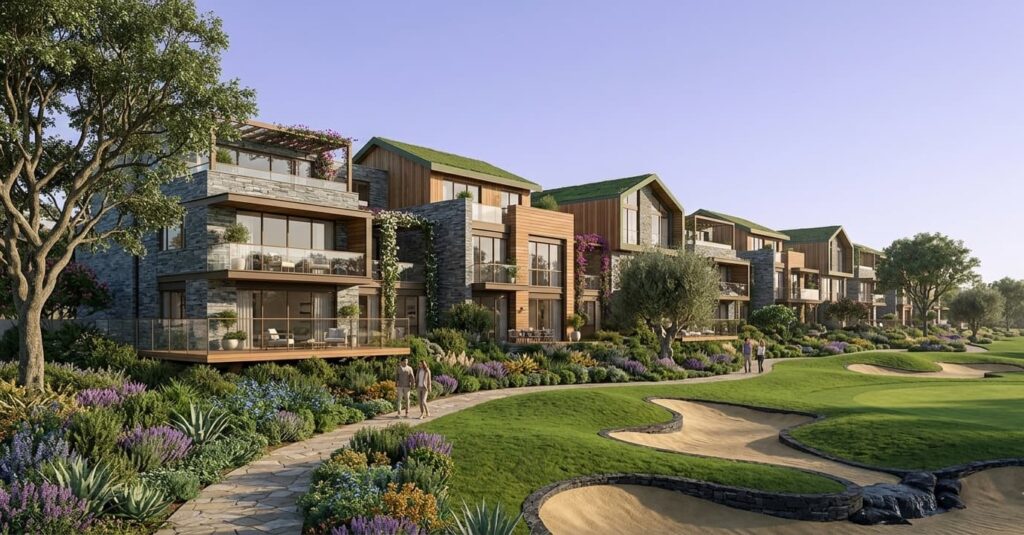
One of the most attractive attributes of land is its versatility. Unlike a constructed building, which is locked into its architectural layout and functional purpose, raw land is a blank canvas. An investor can acquire a large parcel and subdivide it, lease it for agricultural or light industrial use, or hold it for future residential development. For instance, developing premium master-planned areas like the Shyam Kunj Villas luxury township shows how strategic land conversion can yield substantial returns by creating high-end communities that cater to discerning modern buyers.
This adaptability minimizes investment risk. If the demand for office space declines, the land owner can shift plans toward residential zoning. If retail demand falls, the plot can be utilized for storage, urban farming, or green spaces. The ability to pivot based on current market demands ensures that land remains functional and profitable across shifting economic landscapes.
What is the financial benefit of holding land for custom construction?
Many high-net-worth buyers prefer purchasing land within organized communities rather than buying pre-built inventory. This allows them to design bespoke structures that match their lifestyle requirements. Developing highly secure and structured neighborhoods, such as the ultra-luxury homes in Noida, highlights how premium plots in gated layouts attract strong demand, offering buyers both the security of land ownership and the opportunity to build custom architectural designs.
Low Maintenance Costs and Ownership Ease
Why are the operating expenses of land lower than built properties?
Many real estate investors overlook the ongoing operational expenses of owning physical structures. Apartments and commercial buildings suffer from wear and tear, requiring regular investments in plumbing, roofing, HVAC systems, and cosmetic updates. Additionally, managing tenants, dealing with vacancies, and paying property management fees can quickly erode net rental yields. Raw land, however, requires virtually zero active maintenance.
There are no pipes to burst, no roofs to leak, and no tenants to manage. Property taxes on undeveloped land are typically much lower than those on developed properties, making the cost of holding raw land very affordable. For passive investors who want exposure to real estate without the administrative challenges, land offers a peaceful alternative that appreciates quietly in the background.
What administrative legalities must land buyers consider?
While land is highly secure, owners must ensure their transactions are legally sound to prevent future boundary or ownership disputes. Familiarizing yourself with regional zoning guidelines, title verification processes, and our real estate transaction terms is a necessary step in securing your physical asset. Proper documentation and clear terms protect the buyer from regulatory changes and facilitate smooth transfers of ownership in the future.
Mitigating Risk through Developer Partnership
How do structured developer partnerships safeguard investments?
The primary risk associated with raw land investment is encroachment or zoning challenges. Securing land through a respected development partner eliminates these issues. Working with a reputable real estate developer in NCR guarantees that the land has undergone rigorous title verification, environmental assessments, and boundary mapping. Heritage Prime works with experienced legal and engineering professionals to deliver secure, ready-to-develop plots that minimize hurdles for investors.
Furthermore, master-planned developments often include essential infrastructure like roads, water connections, electricity grids, and security systems. This collective development increases the land’s value far faster than isolated raw land, as individual buyers benefit from the developer’s scale and planning expertise.
Real-world structural comparisons of land investment vs other assets
To better understand the risk profile of land, it is helpful to compare it directly with other popular asset classes like equities, commercial buildings, and gold. Below is an overview of how these investments stack up across key factors.
| Asset Class | Risk Level | Maintenance Cost | Inflation Protection | Long-Term Appreciation |
|---|---|---|---|---|
| Raw Land | Low | Extremely Low | Very High | High to Exceptional |
| Equities (Stocks) | High | Zero | Moderate | Volatile |
| Built Property | Medium | High | High | Moderate to High |
| Gold | Low | Low (Storage) | High | Moderate |
Frequently Asked Questions
Why is raw land considered safer than residential apartments?
Raw land does not depreciate over time. Buildings, apartments, and commercial structures suffer from structural wear and tear, aging designs, and outdated systems, which require continuous capital reinvestment to maintain their value. Land, as a physical resource, is permanent and requires no active maintenance, making it a more secure long-term asset class.
How does zoning impact the security of a land investment?
Zoning regulations dictate how a piece of land can be used, whether for residential, commercial, industrial, or agricultural purposes. Investing in land with flexible or favorable zoning reduces risk because it broadens the pool of future buyers. Always verify local master plans to ensure your plot aligns with the region’s long-term infrastructure and development trajectory.
Is land a highly liquid asset compared to mutual funds?
Land is not a highly liquid asset, meaning it cannot be converted to cash instantly like mutual funds or publicly traded stocks. However, this lower liquidity is actually a stabilizing factor. It protects investors from making emotional sales during market panics and ensures that the asset is held for long-term capital appreciation, which typically leads to stronger financial outcomes.
What are the main risks associated with land investments, and how are they avoided?
The primary risks are boundary disputes, title issues, and unauthorized occupation. These risks are easily avoided by purchasing land from reliable, established developers who offer clear title deeds and operate within gated, secured townships. Conducting due diligence on all legal documents and buying within planned developments ensures a safe investment experience.