
Quick Summary
Buying a residential plot in Greater Noida West offers significant capital growth and customization potential. This comprehensive handbook guides you through critical location analysis, legal due diligence, pricing matrices, and step-by-step registration processes. Learn how to secure your property investment and avoid common legal pitfalls in one of the fastest growing real estate hubs in the National Capital Region.
Introduction to Greater Noida West Land Market
Why is Greater Noida West becoming a hotspot for plot buyers?
Greater Noida West, popularly known as Noida Extension, has transitioned from an emerging peripheral zone into a primary residential hub. Driven by systematic urban planning, wider road networks, and proximity to major employment centers, this region attracts individuals looking for long-term capital appreciation and space. Unlike established sectors of Noida where land is scarce and extremely expensive, Greater Noida West provides a mix of authority-allocated plots and private gated community developments at competitive price points. The availability of diverse plot sizes allows buyers to plan residential units matching their exact architectural preferences.
The shift towards plotted developments has accelerated as families seek greater autonomy over their living spaces. Improved civic amenities, dedicated commercial zones, and upcoming retail developments make the micro-market highly self-sustained. According to market observations by Heritage Prime, land parcels in this region have shown resilient demand patterns, outperforming multiple alternative investment classes. The systematic division of sectors, combined with massive green reserves, ensures that the density of population remains balanced, preventing the urban congestion seen in older parts of the National Capital Region.
How does buying land compare to purchasing a pre-built apartment?
Purchasing land provides a level of design flexibility and customization that multi-story apartments simply cannot match. When you own a plot, you retain complete authority over the floor plan, choice of building materials, interior finishes, and future expansion. You can build additional floors as your family grows, subject to local building bylaws, or design open layouts with private gardens and terraces. This high level of personal control makes plotted land highly attractive for long-term family settlements.
From an investment standpoint, land historically appreciates at a faster rate than built-up residential units. While apartments face physical depreciation over time, the value of land is driven upwards by scarcity and progressive surrounding development. Additionally, maintenance costs for vacant land are substantially lower than the monthly society maintenance charges associated with luxury apartments. This makes land a highly cost-effective asset to hold for wealth generation over a multi-decade horizon.
Strategic Location and Connectivity Benefits
What infrastructure developments are driving plot values in Noida Extension?
The primary catalyst for real estate growth in Greater Noida West is the rapid pace of infrastructure implementation. The planned Noida Metro Aqua Line extension, which will run directly through Noida Extension, is set to drastically reduce travel times for daily commuters. The proposed metro route will connect major residential sectors directly with the commercial hubs of Noida and Delhi, providing seamless transit options. Additionally, the development of the Noida International Airport at Jewar has placed the entire region on a global investment map, ensuring consistent long-term demand for nearby properties.
Simultaneously, the Faridabad-Noida-Ghaziabad (FNG) Expressway is evolving into a key regional transit corridor. This expressway will drastically improve cross-city connectivity, linking Greater Noida West directly to Haryana and other parts of Uttar Pradesh. The development of broad arterial roads, underpasses, and multi-lane flyovers has already minimized bottlenecks, making local travel highly convenient. These large-scale civic projects are directly responsible for the upward revision of land values across all prominent sectors.
How does the connectivity to Noida, Greater Noida, and Delhi look?
Greater Noida West boasts excellent geographical positioning, acting as a natural bridge between Noida, Delhi, and Ghaziabad. The sector is located adjacent to the Noida-Greater Noida Link Road, allowing residents to reach central Noida sectors within fifteen minutes. Connectivity to East Delhi is equally efficient via the NH-24 corridor, which has been expanded into a wide expressway. This ensures that professionals commuting to office hubs in central Delhi face minimal delays during peak hours.
Proximity to the Yamuna Expressway also opens up seamless connectivity to southern Uttar Pradesh, facilitating smooth travel for business and leisure. For frequent travelers, the DND Flyway provides direct, signal-free access to South and West Delhi. This strong regional integration means that residents can enjoy the suburban peace of Greater Noida West while remaining fully integrated with the commercial, educational, and medical infrastructure of the wider national capital zone.
Legal and Due Diligence Checklist for Plot Buyers
What documents must you verify before signing a land deal?
Due diligence is the most critical step when purchasing a plot. Unlike apartments where developers manage municipal clearances, land purchases require individual scrutiny of ownership records. Buyers must verify the original Title Deed to confirm the current seller actually owns the property and has the legal right to transfer it. An Encumbrance Certificate for the past thirty years must be obtained from the local sub-registrar office to ensure the land is free from active mortgages, legal disputes, or third-party liabilities.
Additionally, buyers must check the land-use classification. It is vital to verify that the plot is designated for residential use under the regional master plan, as constructing a home on agricultural or industrial land without official land-use conversion is illegal. The Khatauni (land records) and Mutation Register records must also be checked to ensure the seller name matches the official government databases exactly, preventing fraudulent transactions.
How can you check if the plot is registered with GNIDA or RERA?
Any commercial layout or private plotted development spanning more than 500 square meters or comprising more than eight plots must be registered under the Real Estate Regulatory Authority (RERA). Buyers can visit the official UP RERA portal and enter the project registration number to check the project status, approved layout plan, and any past or ongoing litigation. For plots allocated by the Greater Noida Industrial Development Authority (GNIDA), the buyer must request the original allotment letter and lease deed issued by the authority to verify authenticity.
Before transferring any funds, buyers should cross-reference the plot numbers on the official GNIDA sector maps. This ensures that the plot location physically matches the legal descriptions. Checking these official channels safeguards the buyer from unapproved layouts, overlapping land claims, and unauthorized developers who operating outside the legal boundaries set by state planning laws.
| Document Name | Issuing Authority | Primary Purpose |
|---|---|---|
| Allotment Letter | GNIDA / Developer | Confirms initial allocation and payment terms |
| Encumbrance Certificate | Sub-Registrar Office | Proves land is free from pending debts or court cases |
| Mutation Certificate | Local Revenue Department | Records transfer of ownership in revenue registers |
| Approved Layout Plan | GNIDA / UP RERA | Ensures plot structure conforms to local zoning laws |
Types of Plots Available in Greater Noida West
What is the difference between Authority plots and private developer land?
When looking for land in Greater Noida West, buyers generally choose between authority plots and private developer land. Authority plots, which are planned and sold directly by the Greater Noida Industrial Development Authority (GNIDA), are highly secure. These plots are situated within sectors that feature wide roads, planned green belts, municipal water connections, and dedicated commercial areas. They are held on a long-term lease basis, usually 90 years, and require strict adherence to authority-mandated building timelines. Financing for these plots is simple, as most public and private sector banks willingly offer home loans on authority-allocated land.
Private developer plots are situated within gated residential townships. These plots offer freehold ownership rights, allowing buyers more flexibility with transfer and sale. Private developers often provide a wide range of lifestyle amenities including clubhouses, swimming pools, paved walking tracks, and multi-tier security systems. While these plots often command a premium due to the added community infrastructure, they represent an excellent option for families who want to build their custom homes within a secure, managed environment.
What should you look for in a gated community plot?
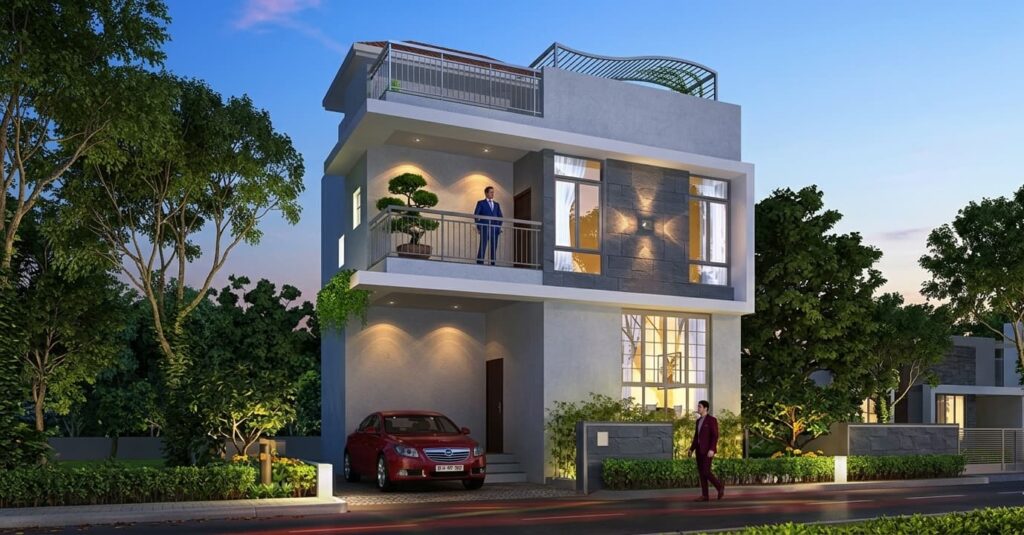
If you prefer a structured neighborhood with high-end infrastructure, you can choose custom building options or select pre-designed layouts like independent homes with modern amenities that combine plot ownership with community living. When evaluating a plot in a gated community, you must inspect the quality of internal roads, underground electrical cabling, rainwater harvesting systems, and sewer networks. Ensure that the developer has secured a clear NOC from the local fire department and environment ministry.
Security is another crucial component. A well-planned gated community should have manned entry and exit points, continuous CCTV monitoring, and restricted access for visitors. It is also important to check the developer track record regarding project maintenance. Ask about the monthly maintenance charges and verify if the resident welfare association (RWA) has a clear governance framework to manage common area services after the developer exits.
Investment Potential and Price Trends
What are the current price trends for residential plots in this zone?
The price of residential plots in Greater Noida West varies depending on the sector, proximity to the main highway, and the availability of basic amenities. On average, land prices have experienced steady growth over the past few years. Sector 1, Sector 2, and Knowledge Park V are highly sought after, with prices ranging from forty thousand to eighty thousand rupees per square yard depending on the category of the plot. Corner plots and those facing wide green belts or parks naturally command a higher premium.
The price differences between raw land and fully developed gated communities are also distinct. Private developers selling plots with completed clubhouses, paved roads, and security infrastructure charge higher rates, but these properties offer immediate livability. In contrast, sector plots offered by the authority might have lower initial acquisition costs but could require more time for the surrounding basic infrastructure to mature completely.
What is the projected long-term return on investment?
The long-term return on investment for plots in Noida Extension remains highly promising. Because land is a finite resource, the rapid rate of population migration to Delhi NCR continues to push land valuations upward. As commercial projects, corporate offices, and retail centers expand along the Greater Noida Link Road, residential demand is projected to rise exponentially. Real estate analysts forecast double-digit annual appreciation for well-located plots over the next five to seven years.
Additionally, the construction of the Jewar Airport is a major driver of regional commercial growth. As corporations set up manufacturing and logistics hubs nearby, housing demand from executives and workers will increase. This creates a strong rental market for independent floor structures built on these plots, providing owners with dual benefits of steady rental income and high capital gains.
Key Localities to Consider for Your Plot Purchase
Which sectors offer the best balance of amenities and value?
Choosing the right sector is essential to ensuring a comfortable lifestyle and maximizing investment returns. Sector 1 and Sector 2 are highly recommended for immediate self-use. These sectors are located close to Noida City, reducing commute times, and already feature operational schools, clinics, and local markets. The green cover in these sectors is well-maintained, providing a quiet and healthy environment for families.
For buyers focused primarily on capital appreciation, sectors near Knowledge Park V and the upcoming metro corridor present exceptional opportunities. While these sectors are still evolving, the planned civic infrastructure, educational institutions, and corporate parks in the vicinity point toward rapid value appreciation. Purchasing plots in these high-potential zones now allows buyers to enter the market at competitive rates before prices rise.
Where can you find upcoming premium residential layout projects?
Several private developers are launching modern plotted developments that feature premium amenities and well-planned community spaces. Many of these projects are situated along the primary arterial roads, offering easy access to Delhi and Ghaziabad. Investors are increasingly looking at upcoming premium housing developments to secure stable long-term returns in these growing sectors, where they can build spacious multi-floor residences.
These developments focus heavily on sustainable design, incorporating open green parks, eco-friendly waste management, and dedicated kids play areas. Investing in these planned developments minimizes the challenges of dealing with individual plot security and municipal approvals, as the master developer handles the initial legal and physical infrastructure work on behalf of the buyers.
Step-by-Step Purchasing Process and Registration
How does the registry and stamp duty process work in Uttar Pradesh?
The process of registering a plot in Uttar Pradesh involves several structured steps. Once the buyer and seller agree on the sale price, they draft a formal Agreement to Sell, detailing the payment schedules, plot dimensions, and handover dates. The buyer then pays the stamp duty, which in Uttar Pradesh currently stands at seven percent for male buyers and six percent for female buyers, calculated based on the higher value between the circle rate and the actual transaction price.
After paying the stamp duty, both parties must schedule an appointment at the local Sub-Registrar office for the final execution of the Sale Deed. Two witnesses with valid identification must accompany the buyer and seller. Working with a reputable real estate developer in NCR guarantees that all local planning authority approvals are fully in place, streamlining the registration process and ensuring a secure transfer of ownership.
What hidden costs should you budget for when buying land?
Many buyers overlook the secondary costs associated with plot purchases, which can significantly impact their overall budget. Beyond the base price of the plot, you must account for External Development Charges (EDC) and Infrastructure Development Charges (IDC) levied by the local authority. These charges cover the cost of developing regional roads, sewage networks, water pipelines, and electrical grids.
Additionally, buyers must budget for registry fee payments, legal consulting fees, loan processing fees, and utility connection charges. If the plot is within a gated community, there may also be one-time club membership and advance maintenance fees. Before finalizing any property transaction, you can get in touch with our real estate consultants to verify title clearings and local zoning rules, helping you avoid unexpected expenses and complete your purchase with confidence.
Frequently Asked Questions
Is it safe to buy Lal Dora plots in Greater Noida West?
Lal Dora plots, which are situated within village habitation boundaries, carry substantial legal risk. These plots often lack official approved layout plans from the Greater Noida Industrial Development Authority (GNIDA) and do not have individual registry papers. Most institutional banks do not provide home loans for Lal Dora properties, and municipal facilities like water and electricity connections can be difficult to secure. For a safe and hassle-free investment, it is highly recommended to stick with GNIDA-approved plots or RERA-registered private developer townships.
Can I get a bank loan for purchasing residential land here?
Yes, most leading public and private sector banks offer specialized land purchase loans for residential plots in Greater Noida West. However, banks typically require the plot to be situated within a government-approved layout or a RERA-registered development. The Loan-to-Value (LTV) ratio for land loans is generally lower than standard home loans, usually ranging between sixty to seventy percent of the property value, and banks often mandate that construction must begin within a specified timeframe, usually two to five years, to qualify for composite land-plus-construction loans.
What is the minimum plot size allowed for construction under GNIDA?
The Greater Noida Industrial Development Authority (GNIDA) has set specific building bylaws governing residential construction. While residential plots in planned sectors can range from sixty square meters to over five hundred square meters, the authority specifies minimum setbacks, ground coverage limits, and Floor Area Ratio (FAR) guidelines based on the overall plot size. Buyers must submit their building plans to GNIDA for approval before beginning any construction on site, ensuring compliance with local safety and environmental standards.
How soon must I start construction after purchasing an authority plot?
GNIDA rules state that buyers who purchase plots directly from the authority must complete a minimum level of construction within a designated period, typically within three to five years from the date of the execution of the lease deed. Failure to construct within the stipulated timeline can result in non-completion penalties levied by the authority, which are calculated as a percentage of the total land cost per year of delay. Extensions can be requested under specific guidelines by paying the necessary extension charges to the authority.