
Quick Summary
Purchasing a residential plot requires careful evaluation of legal, financial, and geographical factors. This comprehensive guide outlines the systematic sequence of buying land, from analyzing location metrics and performing title searches to completing official registration. Discover how proper due diligence ensures a secure asset acquisition and shields you from common real estate disputes.
Understanding the Fundamentals of Buying Land
Why is purchasing land different from buying an apartment?
Acquiring raw land represents a fundamentally different financial and operational strategy compared to acquiring a pre-constructed apartment. When you purchase an apartment, you acquire a specific built-up area along with an undivided share of the land on which the building stands. The building itself is subject to physical depreciation, meaning its structural value decreases over several decades, even as the underlying land value appreciates. In contrast, residential plots represent pure land ownership. The asset does not suffer structural depreciation, and its value is governed entirely by supply, demand, local infrastructure improvements, and zoning alterations.
Additionally, purchasing land places the entire responsibility of construction, layout planning, and utility enablement directly on your shoulders. While apartment buyers rely on developers to manage municipal sanctions, water connections, and electrical wiring, plot buyers must navigate these administrative channels independently or invest in organized developments where these utilities are pre-installed. The legal scrutiny required for plot purchases is also significantly higher because land titles in many developing regions have complex historical ownership records that are prone to disputes.
What are the main benefits of investing in residential plots?
Investing in land offers unparalleled design freedom and high capital appreciation potential. Landowners have the liberty to construct a home that aligns precisely with their architectural tastes, budget, and timeline. You can decide the layout, number of floors, ventilation patterns, and choice of construction materials, which is a level of customization that pre-designed apartments can never match.
From an economic standpoint, plots tend to appreciate faster than built-up homes in high-growth corridors. The initial capital outlay for a plot is often lower than that of a fully constructed house in the same micro-market, making it accessible to a broader demographic of investors. Furthermore, land ownership carries minimal recurring maintenance costs compared to physical buildings, which require ongoing expenses for repairs, painting, and general upkeep. Industry reports from entities like Heritage Prime indicate that well-positioned plots in emerging urban fringes regularly outperform structural properties in terms of raw capital returns over a medium-to-long term horizon.
Step 1: Defining Your Budget and Location Analysis
How should you calculate the actual cost of land acquisition?
Determining the budget for a residential plot goes far beyond the basic advertised rate per square yard or square meter. Buyers often make the critical error of assuming that the plot price is their final expenditure. A comprehensive financial plan must account for several mandatory ancillary expenses that can inflate the total cost by fifteen to twenty-five percent. These include stamp duty and registration charges, local municipal taxes, boundary wall construction fees, land leveling costs, and developer-imposed charges for electricity and water lines.
If you are taking a loan to purchase the land, you must calculate the interest rates, which are typically higher for land acquisitions compared to standard home loans. There is also a distinct tax treatment for land loans: you cannot claim tax deductions on the interest paid until construction begins on the site. Therefore, maintaining a buffer fund of at least twenty percent of the plot cost is highly recommended to manage these immediate post-purchase expenses without facing financial strain.
Which location factors influence long-term land appreciation?
The location of your land determines its future utility and financial yield. When selecting a site, prioritize connectivity to major arterial roads, transit hubs, and employment centers. A plot situated near an upcoming metro station, highway, or industrial corridor will experience a far higher rate of appreciation than one in an isolated zone with poor road connectivity.
Social infrastructure is equally important. Ensure the plot has reasonable access to schools, hospitals, shopping complexes, and grocery markets within a five-to-ten-kilometer radius. Environmental factors must also be assessed: check whether the area is prone to waterlogging during heavy rainfall, verify the quality of groundwater, and confirm that the land is not located near active landfills or heavily polluting industrial units. Evaluating the master plan of the local municipal corporation will help you understand if any heavy industrial zones or high-speed rail lines are planned nearby, which could negatively impact peaceful residential living.
Where can buyers find reliable data on emerging real estate corridors?
Navigating the vast amount of real estate information can be daunting. To make an informed choice, buyers should rely on municipal master plans, government land records portals, and established industry research publications. Reviewing professional insights on a trusted latest property market updates platform provides invaluable clarity on historical price trends, infrastructural developments, and legal shifts across different suburban areas. This data-driven approach prevents emotional purchasing decisions and directs capital toward high-performing zones with low risk profiles.
Step 2: Legal Due Diligence and Title Verification
What legal documents must you verify before purchasing land?
Legal scrutiny is the absolute bedrock of any safe land transaction. Unlike apartments, where developers handle most clearances, plot transactions put the burden of proof entirely on the buyer. You must ensure that the seller has clear, marketable title rights to the property and that the land is free from any litigation, mortgages, or administrative disputes.
The first document to request is the mother deed, which traces the ownership history of the land back thirty to forty years. It must show an unbroken chain of ownership. Next, check the encumbrance certificate, which confirms that the land has no outstanding financial liabilities, loans, or legal disputes. You must also verify the land conversion certificate, which proves that the land has been legally converted from agricultural to residential use by the appropriate government authority. Using agricultural land for residential construction without formal conversion is illegal and can lead to demolition orders.
How do you verify the physical boundaries and zoning regulations?
Paperwork alone is insufficient: you must physically verify the property boundaries. Hire a certified government surveyor to measure the plot coordinates and match them with the layout map approved by the local municipal authority. This ensures that the plot size advertised by the seller corresponds exactly with physical reality and that there are no encroachments from neighboring properties.
Additionally, examine the local zoning laws. Zoning regulations dictate the floor area ratio (FAR), maximum permissible height of the building, and setbacks (the distance you must leave from the boundary walls). If the plot falls under a green zone, forest buffer area, or near a high-voltage power transmission line, you may face severe construction restrictions or a complete ban on building residential structures.
| Document Name | Primary Purpose | Critical Verification Point |
|---|---|---|
| Title Deed / Mother Deed | Proves the historical ownership chain of the land. | Ensure no breaks in the transfer sequence over the last 30 years. |
| Encumbrance Certificate (EC) | Confirms the land is free of outstanding loans or court disputes. | Verify the EC covers a continuous period of at least 30 years. |
| Land Conversion Certificate | Proves conversion from agricultural to non-agricultural/residential use. | Check for official signature and order number from the District Collector. |
| Layout Approval Map | Shows the sanctioned layout of the plotting project. | Verify stamp of approval from the local town planning authority. |
Step 3: Assessing Infrastructure and Amenities
What basic infrastructure should exist before you buy?
Before finalizing any land deal, you must inspect the immediate physical infrastructure. A plot located in a layout with wide, paved roads is far more valuable than one accessed via narrow dirt pathways. Ideally, roads within the residential sector should be at least nine to twelve meters wide to accommodate heavy construction vehicles and daily traffic comfortably.
Equally vital is the availability of basic utilities. Verify if there is a municipal water supply line nearby or if the groundwater is potable and easily reachable through borewells. Check for the proximity of electricity transformers, street lighting, and telecom lines. Adequate drainage systems must be built alongside the access roads to prevent flooding during heavy rains. Buying a plot in an area lacking these basic systems means you will face exorbitant costs to bring these lines to your property independently in the future.
How does township development compare to standalone plots?
Standalone plots are often cheaper but carry significant operational risks, including land encroachment, lack of community security, and delays in utility provision. In contrast, purchasing land within an organized township or planned community offers peace of mind. These developments are managed by professional real estate firms that handle layout approvals, utility installations, and common security infrastructure before selling individual units.
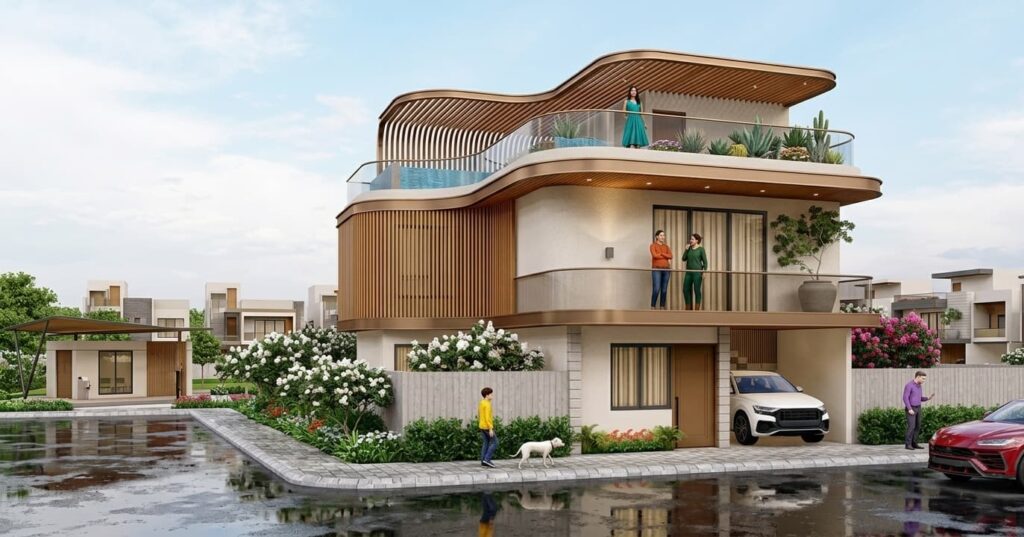
For buyers seeking structured living within premium environments, selecting planned layouts is a highly efficient option. For instance, planned communities such as the Ayodhya Enclave luxury villa project offer a balanced blueprint where individual land ownership meets pre-built common infrastructure and high security standards. This layout format ensures that the property is secure, has accessible paved roads, and features planned green parks, resolving the issues common to raw, scattered land.
Step 4: Booking, Agreement for Sale, and Financial Planning
What are the terms included in an allotment letter and sale agreement?
Once you satisfy yourself with the physical and legal checks of the property, the next phase is formalizing the transaction. You begin by paying a small earnest money deposit or token amount to the seller, in exchange for which they issue an allotment letter or booking receipt. This document locks the property price and prevents the seller from entertaining other buyers for a specific timeframe.
Following this, a detailed Agreement for Sale is drafted. This legal document binds both parties to the transaction. It must detail the exact dimensions of the plot, the total agreed purchase price, the payment schedule, and the consequences of default by either the buyer or the seller. The agreement should explicitly state that the seller must hand over the property free of all encumbrances and complete the registration once the full payment is made. Both parties must sign this agreement, and it is highly recommended to register the Agreement for Sale with the local authority to give it solid legal validity.
What financing options are available for purchasing residential plots?
Securing financing for land differs from obtaining a standard home loan. Banks treat land loans with a higher level of caution because undeveloped land does not generate immediate rental income and is harder to liquidate in the event of default. Consequently, the loan-to-value (LTV) ratio for plot loans is usually limited to sixty or seventy percent of the property value, requiring the buyer to fund the remaining thirty to forty percent out of pocket.
Furthermore, the loan repayment tenure for residential plots is typically shorter, often capped at fifteen years instead of the thirty-year tenure standard for built homes. Banks also stipulate that the plot must be situated within municipal limits or in development authority approved layouts. If you intend to build your home on the plot, you can explore composite loans, which bundle the land purchase cost and construction cost into a single loan structure, allowing you to access better interest rates and longer repayment tenures.
Step 5: Registration and Stamp Duty Formalities
How does the official registration process work at the Sub-Registrar office?
The final legal transfer of ownership occurs during the registration of the Sale Deed. The registration process must take place at the local Sub-Registrar office having jurisdiction over the area where the plot is situated. Before the registration date, you must purchase stamp papers of the correct value. The stamp duty rate is calculated as a percentage of the total property value or the government circle rate, whichever is higher.
On the day of registration, both the buyer and the seller, along with two independent witnesses, must physically present themselves at the office. The registrar will verify the identity of all parties, examine the original legal documents, collect the registration fees, and record the biometric data of the signatories. Once the registrar is satisfied with the paperwork, the document is officially registered, and a unique registration number is issued, formally transferring the title of the land to your name.
What are the post-registration steps to secure property ownership?
Completing the registration is a major milestone, but your responsibilities do not end there. You must obtain the registered Sale Deed from the office, which typically takes a few days. Once in possession of this deed, your next step is to apply for property mutation in the local municipal or revenue office. Mutation is the process of updating the government tax records to reflect your name as the new owner of the land.
Without mutation, the property tax bills will continue to be generated in the name of the previous owner, which can create serious legal complexities if you decide to sell the property or apply for building approvals in the future. After successful mutation, pay the property tax in your name and secure the receipt. Finally, erect a visible, sturdy boundary wall or fence around your plot and display a sign board indicating your ownership and contact details, which acts as a powerful deterrent against unauthorized trespassing or encroachment.
Exploring Alternative Residential Solutions
When should you consider buying pre-built luxury homes instead of raw land?
While buying a plot offers endless creative freedom, the journey of constructing a home can be stressful, time-consuming, and complex. Dealing with architects, structural engineers, government approval departments, and local construction contractors requires a massive investment of time and energy. Material price volatility can also lead to budget overruns, making final costs hard to predict.
For professionals who value convenience, time savings, and immediate high-end living standards, bypassing raw land purchase in favor of fully constructed premium residences is a compelling choice. This path provides a ready lifestyle with premium architecture, professionally landscaped gardens, and high-end security. Those looking for sophisticated design without the personal labor of supervision often explore ready-to-move-in luxury independent villas in Noida, which merge independent ownership with upscale shared features.
What are the top upcoming premium housing developments in the region?
If your interest lies in exploring high-growth zones with well-developed infrastructure, keeping an eye on modern master-planned complexes is essential. The region features several micro-markets that provide a balance of green open spaces, premium finishes, and connectivity. By keeping track of the latest real estate projects in Delhi NCR, investors can identify communities that feature both vacant premium plots and fully built executive villas. This evaluation helps you determine if your capital is better deployed in constructing a house from scratch or in acquiring an exquisitely designed modern home in an exclusive gated community.
Frequently Asked Questions (FAQ)
What is the difference between agricultural land and residential plots?
Agricultural land is designated solely for cultivation and farming activities. It is illegal to construct permanent residential structures on it unless you obtain a formal Land Conversion Certificate from the state government. Residential plots, on the other hand, are situated in zones already cleared by town planning authorities for housing construction, meaning they have pre-approved zoning rights.
Is it possible to get a home loan for purchasing a plot?
Yes, you can obtain a plot loan (often called a land purchase loan) from major financial institutions. However, these loans are structured differently from home loans. They typically require a higher down payment (often 30-40%), offer shorter repayment tenures, and carry slightly higher interest rates. Many banks also require you to start construction within a specified timeframe to avail of standard home loan tax benefits.
What is an Encumbrance Certificate and why is it necessary?
An Encumbrance Certificate is an official document issued by the sub-registrar office proving that the property is free from any financial liabilities or legal disputes. It details all recorded transactions on the land, such as mortgages, leases, or court attachments. Verifying a clean Encumbrance Certificate for at least 30 years ensures that you are not buying a property that has been pledged as collateral for an unpaid loan.
How do local zoning laws impact plot usage and construction?
Zoning laws dictate exactly what can be built on the land, including the maximum height of the building, the permissible Floor Area Ratio (FAR), the required setbacks from the boundary lines, and the proportion of the plot that must remain as open space. Violating these municipal zoning laws will result in your building plans being rejected, heavy fines, or even demolition of unauthorized construction.