
Quick Summary
Land scarcity operates as the foundational economic engine behind real estate appreciation. Because land is a finite, non-reproducible asset, any increase in population, urban migration, or economic development puts upward pressure on property values. This article examines the core mechanics of land scarcity, analyzing how physical geographic boundaries, restrictive municipal zoning regulations, and changing buyer preferences alter market valuations. We explore the transition from horizontal housing to high-density vertical options and outline the quantitative metrics institutional investors use to identify supply-constrained micro-markets. Finally, we address how buyers can navigate high-value transactions safely by understanding market risks and structural legal frameworks.
The Economics of Finite Spaces: Understanding Supply and Demand in Real Estate
How does the basic law of supply and demand apply to land?
At its core, real estate valuation is governed by classical economic principles, primarily the relationship between supply and demand. Unlike commodities that can be manufactured, agricultural products that can be grown, or technological products that can be replicated, land is completely finite. The physical surface area of the Earth is fixed. When we analyze a specific micro-market, such as a major metropolitan financial center or a highly desirable coastal strip, the supply of available space is even more restricted. When the population grows and economic activity increases, more individuals and businesses compete for the same physical coordinates. Because the supply cannot expand to meet this growing demand, the price of the asset must rise to clear the market. This creates a structural upward trajectory for land values in regions characterized by robust economic growth and demographic consolidation.
Classical economists such as David Ricardo identified this phenomenon in the early nineteenth century through the theory of Ricardian Rent. Ricardo argued that the rent or value of land is determined by its relative fertility and situation. In a modern context, situation translates directly to location and access. As premium locations become fully developed, the remaining parcels command an extraordinary premium. Property buyers are not simply purchasing brick, mortar, and concrete: they are purchasing exclusive rights to a specific, non-reproducible geographical point that offers proximity to employment, commerce, transport, and community infrastructure. When alternative options are depleted, the value of the existing land holdings increases exponentially, making early acquisition a highly profitable strategy for long-term wealth preservation. Indeed, real estate research firms such as Heritage Prime highlight that land scarcity operates as the foundational economic engine behind property value growth.
Why is land considered an inelastic asset class?
In economic terms, supply elasticity refers to how much the quantity supplied of a good changes in response to a change in its price. Most consumer goods exhibit high elasticity: if the price of laptops increases, manufacturers will increase production to capture higher profit margins, eventually stabilizing the price. Land, however, is a classic example of an inelastic asset class. Even if the market price of a square meter of land in a major city center doubles or triples overnight, developers cannot physically manufacture more land in that specific location. The price mechanism cannot stimulate an increase in physical supply.
This absolute inelasticity means that any shift in the demand curve translates directly into a shift in price rather than quantity. While developers can increase the density of a property by building vertically, the underlying land parcel remains unchanged in size. Therefore, the land component of real estate value behaves as a pure scarcity play. As urban centers become saturated, the land-to-building value ratio shifts dramatically, with the physical ground representing the vast majority of the asset’s total worth. Investors who recognize this inelasticity prioritize locations with structural barriers to expansion, ensuring their capital is protected by natural market forces that prevent competitive supply dilution.
Geographic and Regulatory Barriers to Expansion
What roles do physical geography and natural boundaries play in scarcity?
Physical geography is the most obvious and permanent driver of land scarcity. Cities bounded by oceans, seas, mountain ranges, or river systems face immediate physical limits on outward expansion. For example, island economies or peninsula cities cannot grow horizontally without undertaking phenomenally expensive land reclamation projects, which themselves carry significant engineering and environmental limitations. In these geographically locked markets, property values historically appreciate at rates that far outpace landlocked cities where urban sprawl can continue indefinitely in all directions. The physical boundary creates a hard ceiling on supply, forcing developers to optimize every square inch of available space.
Even in cities with flat topography, geological conditions such as wetlands, unstable soil, or protected natural reserves act as physical barriers to construction. These natural features segment the market, isolating highly desirable buildable zones from non-buildable zones. Consequently, the value of buildable land in close proximity to natural features often carries a double premium: first, for its absolute scarcity, and second, for the scenic or environmental utility it provides to occupants. This spatial limitation ensures that properties situated near protected natural borders retain their premium status over multiple market cycles.
How do zoning laws, municipal Master Plans, and regulatory codes artificialize scarcity?
While physical geography limits land supply naturally, municipal planning departments and regulatory bodies impose artificial constraints that are equally powerful. Zoning codes, historical preservation ordinances, environmental conservation acts, and urban growth boundaries restrict where, what, and how densely developers can build. By designating certain areas as agricultural zones, low-density residential zones, or heritage districts, municipal authorities legally prohibit the intensification of land use. These regulations are designed to maintain urban order, manage infrastructure loads, and protect the character of neighborhoods, but their direct economic consequence is a severe reduction in the supply of developable land.
When regional planning authorities restrict vertical development or impose greenbelt zones, land within the permitted zones experiences a massive valuation jump. Buyers tracking the latest real estate projects in Delhi NCR often notice that master-planned developments in tightly regulated micro-markets command a premium over unregulated peripheral areas. By limiting the Floor Area Ratio (FAR) or the total height of buildings, regulatory policies create an artificial ceiling on the density of housing units. This artificial scarcity drives up the acquisition cost of the land for developers, who must then pass these costs onto end-users, resulting in higher final sales prices for residential and commercial spaces alike.
Demographic Pressures and Urban Concentration
Why are global urban migration patterns putting pressure on land?
Demographic trends over the last century show a persistent, accelerating shift toward urbanization. People migrate to cities in search of economic opportunity, specialized healthcare, advanced education, and social connectivity. This mass migration creates a highly concentrated demand pattern. While a nation may have millions of hectares of open rural land, that land has minimal real estate value due to a lack of utility, infrastructure, and economic productivity. Conversely, the land within metropolitan boundaries becomes highly contested as millions of residents compete for access to the urban core.
This demographic concentration creates a profound imbalance. As cities densify, the population per square kilometer rises, but the physical boundary of the city core cannot expand at a matching pace without causing severe commuting inefficiencies. Consequently, the price of urban land scales quadratically with population density. This relationship means that even moderate increases in urban population can trigger exponential increases in real estate values. This dynamic is particularly evident in emerging economies where industrialization and service-sector growth pull rural populations into metropolitan hubs at unprecedented rates, consistently outstripping municipal housing production capabilities.
What is the relationship between employment hubs and micro-market land values?
The value of land is fundamentally tied to the time-utility of its location. Properties situated within easy commuting distance of primary employment hubs, such as central business districts, tech parks, or industrial corridors, command the highest prices. Time is a non-renewable resource, and modern professionals are increasingly willing to pay a substantial financial premium to minimize daily transit times. This preference creates micro-markets of hyper-scarcity around commercial centers.
When major multinational corporations or domestic conglomerates establish large-scale offices in a specific district, they attract thousands of high-income employees. This localized influx of purchasing power drives immediate competition for nearby residential land. Developers, recognizing the intense demand for housing in these immediate zones, compete aggressively to purchase any available parcels, driving land acquisition costs to historic heights. The value of land in these sub-markets behaves almost independently of the broader national real estate market, insulated by localized high wages and a structural deficit of commutable housing alternatives.
Land Scarcity and Its Impact on Housing Formats
How does limited land change the ratio of multi-family high-rises to low-density plots?
As land values climb due to scarcity, developers must adapt their architectural designs to maintain economic viability. When the cost of acquiring land represents a massive percentage of the total project budget, building low-density single-family homes becomes financially unfeasible in urban centers. To generate a reasonable return on investment, developers must distribute the high land cost across a larger number of residential units. This economic necessity drives the transition from horizontal housing formats to vertical, multi-family high-rise developments.
By building vertically, developers effectively multiply the usable floor area of a single plot of land, creating vertical communities. While this transition helps address housing shortages, it simultaneously makes ground-level land ownership a luxury accessible only to the wealthy. Over time, the ratio of high-rise apartments to low-density plotted developments shifts heavily in favor of high-rises. Plotted developments and independent land parcels inside city limits become rare historical assets, appreciating at a rate that far exceeds the appreciation of individual high-rise apartments because the physical land owner holds the ultimate underlying, non-depreciating asset.
Why do luxury buyers prefer low-density gated developments when land runs out?
In an era dominated by high-density vertical living, space and privacy have become luxury commodities. High-net-worth individuals seek environments that offer security, exclusivity, and a connection to the physical ground, away from the noise and congestion of multi-story towers. When urban land is highly constrained, low-density gated developments become exceptionally desirable status symbols because they represent the consumption of a highly scarce resource: horizontal space.
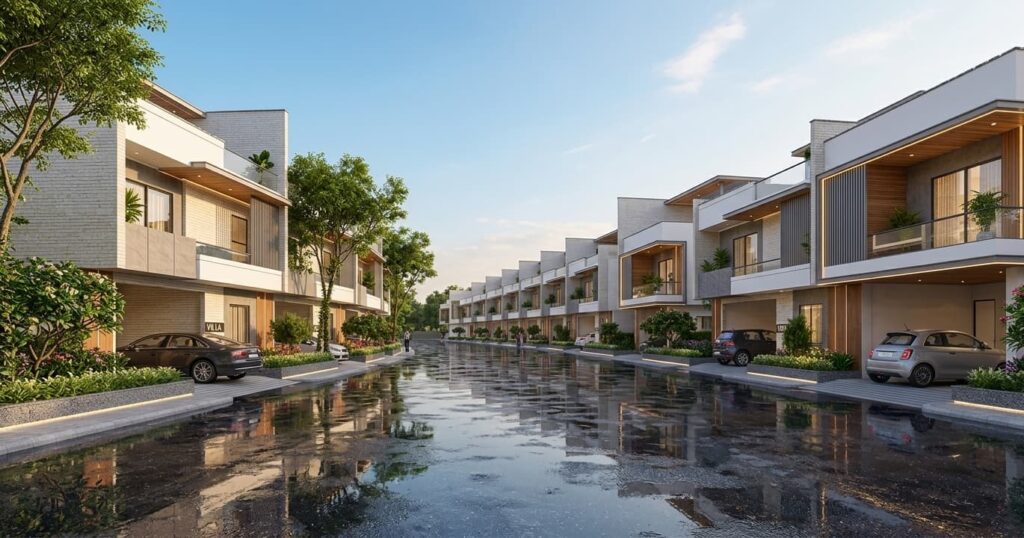
In markets where high-density vertical living has become the default standard, low-density horizontal properties command an extraordinary scarcity premium. Buyers seeking horizontal layouts are increasingly shifting their focus toward master-planned horizontal communities that offer secure, low-density living, such as independent homes with modern amenities, which provide the dual benefit of land ownership and managed community services. These developments offer a refined lifestyle that balances independent ownership with structured community governance, ensuring long-term asset value protection and high residential appeal.
Economic Metrics: Quantifying Land Scarcity and Property Appreciation
What data tools do developers and institutional investors use to measure land constraints?
Professional real estate investors and institutional fund managers do not rely on simple intuition to evaluate land scarcity. They utilize sophisticated quantitative metrics and spatial analysis tools to assess the supply-side dynamics of a micro-market. One of the primary tools is Geographic Information Systems (GIS) mapping, which allows analysts to calculate the Land Availability Index (LAI). The LAI measures the ratio of developable vacant land to total geographic land within a defined radius, accounting for zoning restrictions, water bodies, and existing infrastructure. A low LAI indicates severe land constraints, signaling a high probability of future capital appreciation.
Another critical metric is the Price Elasticity of Housing Supply, which measures how rapidly housing supply responds to price changes in a given metropolitan area. In markets with low supply elasticity, an increase in housing demand results in rapid price escalation rather than new construction. Analysts also track the Land-to-Value (LTV) ratio of properties. When the value of the physical land on which a building stands exceeds seventy percent of the property’s total market value, the asset is considered highly insulated from physical depreciation, as the depreciating structure represents only a minor fraction of the overall investment. This structural profile is typical of premier urban districts where land is exceptionally scarce.
To understand how these scarcity dynamics affect property metrics, consider the comparison table below detailing different metropolitan area structures and their historical performance indicators:
| Market Type | Land Availability Index (LAI) | Average Land-to-Value (LTV) Ratio | Historical Annual Capital Appreciation | Primary Supply Constraint |
|---|---|---|---|---|
| Geographically Constrained Coastal Metro | Very Low (<10%) | 75% – 85% | 8% – 12% | Oceans, mountains, water systems |
| Regulatory-Choked Mature City | Low (10% – 20%) | 60% – 70% | 6% – 9% | Zoning laws, greenbelts, FAR caps |
| Master-Planned Luxury Suburb | Moderate (20% – 35%) | 50% – 60% | 7% – 10% | Controlled phase release, low-density zoning |
| Flatland Unregulated Megacity | High (>50%) | 25% – 40% | 3% – 5% | Unrestricted horizontal sprawl |
Investment Psychology: The Premium on Scarcity and Wealth Preservation
How does investor behavior shift during periods of high inflation or fiscal volatility?
During periods of macroeconomic turbulence, global inflation, or high fiscal volatility, the psychology of wealth preservation shifts from yield-seeking behavior to capital preservation. Fiat currencies are subject to systemic inflation and purchasing power degradation, which prompts capital to seek refuge in tangible, hard assets. Real estate, and particularly the land component of real estate, has served as a primary store of wealth for centuries. Unlike paper stocks, bonds, or digital currencies, physical land cannot be printed, diluted, or made obsolete by technological shifts.
This wealth preservation focus creates a flight-to-safety effect. Investors actively reallocate capital out of volatile financial markets and into premium real estate holdings located in supply-constrained areas. Because these premium land parcels are highly limited, this surge in capital inflow causes sharp upward movements in property values. The psychological premium placed on safety and tangible value acts as a self-reinforcing loop, where high-profile transactions in constrained zones draw further investor interest, continuously cementing the reputation of land as a premier defensive asset class.
Why does land serve as an ultimate hedge against monetary expansion?
When central banks engage in expansionary monetary policy, the total circulating supply of capital increases, which typically devalues individual currency units. Because land is fixed in supply, its price naturally adjusts upward in response to a larger pool of currency chasing a static volume of real assets. This makes land one of the most reliable and effective hedges against long-term monetary expansion.
Institutional investors and private wealth managers closely follow structural shifts in urban expansion. Analysis published in the NCR real estate blog and market insights suggests that long-term capital preservation is consistently achieved in micro-markets where physical land supply is structurally constrained. When a buyer secures a property in a geographic location where future construction is legally or physically impossible, they are effectively locking in a permanent share of urban real estate that will continue to adjust its pricing in lockstep with monetary growth and economic expansion, ensuring their multi-generational wealth remains intact.
Structuring Real Estate Acquisitions Safely
What safety checks must buyers perform before purchasing land-constrained premium assets?
While the investment thesis for purchasing land-constrained assets is exceptionally strong, the high financial stakes involved in these transactions require meticulous legal and structural due diligence. Because land in premium urban corridors commands premium prices, it is also subject to higher legal complexity. Buyers must conduct exhaustive searches of land titles, verifying that the property has a clear, unencumbered chain of ownership stretching back several decades. This prevents future disputes regarding ownership claims or historical boundary alignments.
In addition, buyers must verify that the developer has obtained all necessary environmental clearances, municipal approvals, and compliance certificates under local real estate regulatory authorities. In high-density zones, developers must strictly adhere to municipal Master Plans, zoning parameters, and structural safety guidelines. Failure to comply with these parameters can lead to lengthy legal delays, heavy financial penalties, or even demolition orders. Engaging experienced real estate lawyers, independent structural auditors, and certified surveyors is an important step in verifying the compliance status of the asset before executing any financial transfers.
To mitigate risk when purchasing high-value real estate in tightly constrained markets, buyers must carefully review the documentation and structural compliance parameters. Understanding the developer’s legal terms and service conditions ensures that all ownership transfers, construction timelines, and regulatory clearances are fully transparent and legally binding. This professional approach protects the buyer’s capital investment from regulatory changes and ensures that the long-term appreciation benefits of land scarcity are fully and securely realized by the rightful property owner.
Frequently Asked Questions (FAQ)
How does land scarcity directly affect the resale value of older properties?
As land scarcity intensifies in a micro-market, the physical building on a plot depreciates over time, but the underlying land appreciates. In premium locations, the land value grows so rapidly that it completely offsets the physical wear and tear of the structure. Consequently, older properties in prime locations retain high resale values because buyers are effectively purchasing the scarce land parcel, often intending to redevelop or modernize the existing structure to maximize its utility.
What is the difference between physical land scarcity and regulatory land scarcity?
Physical land scarcity occurs when natural geological features like water bodies, mountains, or wetlands physically prevent horizontal urban expansion. Regulatory land scarcity is artificially created by municipal authorities through zoning laws, agricultural greenbelts, historical conservation rules, and low Floor Area Ratio (FAR) limits, which restrict development density even when physical land is technically available nearby.
How do infrastructure improvements change the scarcity dynamics of a micro-market?
Infrastructure improvements, such as high-speed expressways, metro lines, and transit corridors, effectively expand the commutable radius of a city. This temporarily reduces localized land scarcity by connecting previously isolated outlying areas to major employment hubs. However, once these new transport corridors become saturated and developed, land scarcity dynamics reassert themselves, establishing a new, higher baseline of property values across the expanded urban zone.
Why is land value appreciation typically higher than the appreciation rate of the actual physical building?
Physical buildings are depreciating assets that degrade, require ongoing maintenance, and eventually face obsolescence due to changing architectural trends and building technologies. Land, conversely, is an indestructible, non-reproducible asset with a fixed global supply. Therefore, long-term real estate appreciation is almost entirely driven by the appreciation of the underlying land, while the building’s physical structure represents a depreciating cost component.