
Quick Summary
Greater Noida is undergoing a massive real estate transformation driven by systematic urban planning, the upcoming Noida International Airport at Jewar, and expanding metro networks. Key corridors like Noida Extension, Yamuna Expressway, and the sectors along the Greater Noida Expressway offer diverse residential opportunities, ranging from high-rise apartments to premium low-density villa communities. This comprehensive guide analyzes these micro-markets, structural trends, and long-term investment prospects for homebuyers and investors.
The Evolution of Greater Noida as a Premier Residential Hub
What drives the demand for residential properties in Greater Noida?
Greater Noida was conceived as a highly organized urban extension of the National Capital Region. Unlike older cities that suffered from unplanned expansion, this region was mapped out with wide arterial roads, dedicated industrial zones, and a high percentage of green cover before the first residential layouts were constructed. The presence of major manufacturing plants, technology centers, and educational institutions has created a steady stream of employment opportunities. This job creation naturally fuels the demand for high-quality housing, attracting families who seek a cleaner environment, wider roads, and better municipal planning than what is currently available in neighboring congested metropolises.
Affordability combined with extensive structural layout planning has made Greater Noida a prime target for middle-income and premium home buyers. As land values in central Noida and Delhi continue to climb, buyers find that they can secure larger properties with superior amenities in Greater Noida for similar or lower prices. This value proposition has shifted the market from being purely speculative to a mature, end-user-dominated residential environment.
How does infrastructural expansion impact land value in this zone?
Infrastructure acts as the primary catalyst for property valuation in Greater Noida. The Greater Noida Industrial Development Authority (GNIDA) and the Yamuna Expressway Industrial Development Authority (YEIDA) have implemented systematic master plans that emphasize transport corridors. Each major transit addition, whether it is the expansion of the Aqua Line Metro or the development of peripheral expressways, directly correlates with a rise in regional property values. Modern buyers prioritize accessibility, and properties connected directly to major highway systems command a premium.
The ongoing development of civic amenities, such as underground cabling, modern waste management systems, and smart water networks, has further solidified the region\’s reputation as a well-planned zone. The integration of commercial districts, IT parks, and residential sectors ensures that residents do not need to travel long distances for daily activities, which in turn raises the long-term desirability and valuation of residential plots and residential buildings across these sectors.
Top Residential Growth Corridors in Greater Noida
Why is Noida Extension (Greater Noida West) still a major hotspot?
Noida Extension, officially known as Greater Noida West, remains one of the most active micro-markets in the National Capital Region. The primary draw of this corridor is its ability to cater to large-scale residential requirements. Developed with high-density residential towers, this region is highly favored by young professionals and families entering the homeownership market. The availability of structured group housing projects with integrated clubhouse amenities, central parks, and perimeter security has made it a preferred alternative to older, unorganized colonies in Delhi.
Connectivity to central Noida via the Hindon Bridge and direct routes linking to the crossing of National Highway 24 and the Noida Expressway make daily commuting straightforward. In addition, the upcoming expansion of the metro line deeper into Noida Extension will resolve long-term transit concerns, ensuring that public transport is highly accessible for the entire populace. Retail centers, multi-specialty hospitals, and reputed international schools are already fully functional, making it a self-sufficient residential zone.
What makes the Yamuna Expressway a highly sought-after investment destination?
The Yamuna Expressway corridor represents the long-term frontier of urbanization in the region. Spanning from Greater Noida to Agra, the initial sectors of this expressway are experiencing rapid residential, industrial, and commercial development. Investors are drawn to this zone due to the vast expanses of land available for systematic planning. The corridor is characterized by large-scale plotted developments, smart-city layouts, and mixed-use integrated townships that prioritize open spaces and modern infrastructure.
The presence of major industrial clusters, such as the electronic manufacturing clusters, toy cities, and apparel parks, provides a robust economic base for the residential developments. These employment hubs ensure that the demand for housing along the expressway is supported by stable local job opportunities, rather than relying solely on commuters traveling to Noida or Delhi. This economic foundation protects the micro-market from volatile speculative bubbles and provides a solid basis for organic rental demand.
How are Sector 150 and the Greater Noida Expressway changing the premium housing landscape?
The sectors lining the Greater Noida Expressway are synonymous with premium residential living. While some of these sectors fall under the Noida planning authority, their proximity to Greater Noida and shared transit systems make them key parts of the broader growth narrative. Sector 150, situated at the confluence of the Yamuna and Hindon rivers, has been developed as a low-density green sector. The authority has mandated that a major percentage of this sector remain green, resulting in massive parks, golf courses, and sports-themed residential projects.
The demand for low-density housing has intensified as buyers look for spacious environments away from crowded city centers. Buyers interested in premium configurations, such as luxury independent villas in Noida, find that the open planning, high security, and clean environment of Sector 150 and the adjacent Greater Noida expressway sectors match their high standards. The seamless access to Delhi, central Noida, and Greater Noida via the wide expressway network makes these sectors highly desirable for senior corporate executives and business owners.
Comparative Analysis of Top Micro-Markets
To understand the diverse options available across Greater Noida, it is helpful to analyze the key attributes of each major residential corridor. The table below outlines the price dynamics, connectivity parameters, and primary buyer profiles for the three most prominent zones.
| Growth Corridor | Average Price Range | Primary Transit Links | Dominant Property Types | Target Audience |
|---|---|---|---|---|
| Greater Noida West | Moderate | Hindon Bridge, Link Road, Proposed Metro | High-Rise Apartments | Mid-income families, IT professionals |
| Yamuna Expressway | Entry to Moderate | Yamuna Expressway, Eastern Peripheral | Plots, Mid-Rise apartments, Townships | Long-term investors, second-home buyers |
| Expressway Sectors (Sector 150) | Premium | Noida-Greater Noida Expressway, Aqua Line Metro | Low-Density Condos, Gated Villas | High-net-worth individuals, executives |
This classification illustrates that while Greater Noida West is ideal for buyers looking for immediate occupancy and modern high-rise living within a reasonable budget, the Yamuna Expressway is better suited for capital appreciation over a slightly longer horizon. Conversely, the sectors situated along the main Greater Noida Expressway cater directly to the premium housing segment, placing a heavy premium on low density, privacy, and extensive green open spaces.
Emerging Luxury Real Estate Trends in Greater Noida
Are luxury gated communities and private residences gaining traction?
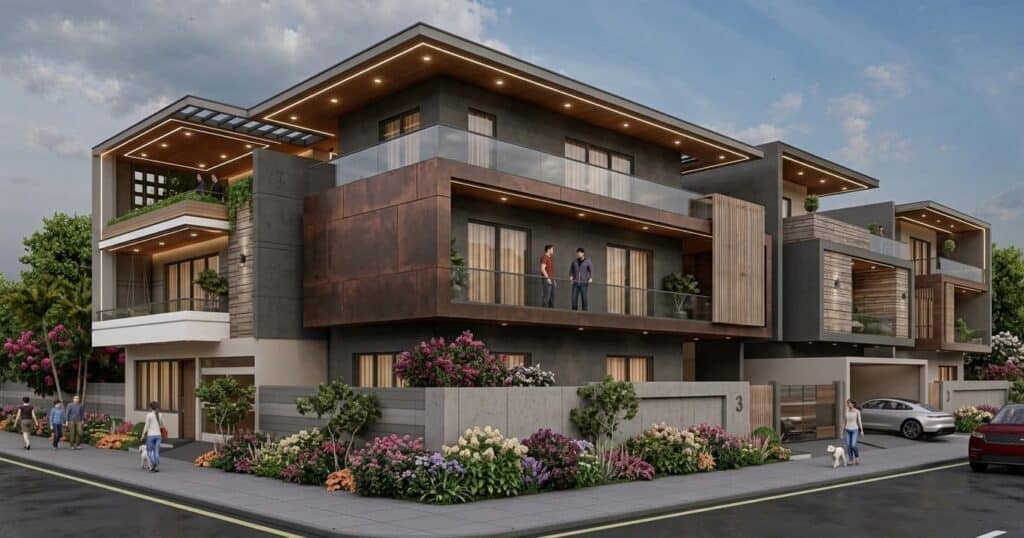
There is a distinct shift in the preferences of affluent buyers who are moving away from congested high-rise structures toward independent, low-density residences. This structural shift has intensified the demand for specialized developments that provide both private living and shared community benefits. High-net-worth buyers prioritize controlled-access points, sophisticated security management, and personalized leisure amenities within their residential developments. This changing behavior is clearly visible in the popularity of developments like the Palm Villas Noida gated community, which caters to the expectation of a quieter, private lifestyle without sacrificing connectivity to major urban centers.
Modern private residences are designed with expansive layouts that incorporate dedicated spaces for home offices, private home theaters, and personal outdoor spaces. Developers are responding by incorporating luxury finishes, modular kitchens, and energy-efficient architecture. These properties provide a clear alternative to traditional apartments, allowing buyers to custom-design their interiors while benefiting from professional facility management, continuous water supply, and uninterrupted back-up power systems.
What roles do green spaces and sustainability play in modern master planning?
Sustainability is no longer a minor consideration in residential selection; it is a major factor shaping modern developments. Buyers are highly conscious of air quality index levels, regional temperatures, and water scarcity. Consequently, gated developments and townships are incorporating large-scale environmental features. Integrated projects, such as the Shyam Kunj Villas luxury township, illustrate how developers are blending spacious independent homes with modern amenities like advanced rainwater harvesting systems, solar-powered common lighting, and carefully designed native flora landscapes that demand less water.
The presence of vast central parks, clean walking tracks, and open-air recreation areas inside the perimeter helps create a favorable microclimate within these premium communities. This planning reduces ambient noise, filters local dust, and lowers temperatures, offering a peaceful environment that stands in sharp contrast to the concrete density of central NCR. Heritage Prime analysts note that residential assets incorporating active green initiatives and circular water management show higher long-term demand and better value retention.
Future Outlook and Smart City Infrastructure
How will the upcoming Noida International Airport at Jewar transform regional property dynamics?
The construction of the Noida International Airport at Jewar is the most significant economic driver in northern India. Once operational, the airport will drastically reduce transit times for international business travelers and cargo, turning the entire Yamuna Expressway and Greater Noida region into a major commercial and logistics gateway. This global connectivity will attract multinational corporations, hospitality chains, and retail giants, leading to massive employment generation along these growth corridors.
The residential markets closest to the airport and its connecting expressways will see a direct benefit from this economic shift. To monitor these structural movements, reviewing an expert NCR real estate blog and market insights is helpful for tracking structural updates, layout permissions, and price movements across these corridors. As commercial flights begin operations, demand for premium corporate housing, serviced apartments, and luxury villas near the transit corridors is expected to rise sharply, leading to significant capital appreciation.
What are the primary commercial and industrial drivers of residential growth?
Residential growth does not happen in a vacuum; it requires a strong industrial and commercial foundation to sustain it. Greater Noida has successfully positioned itself as a major manufacturing and technology hub. The presence of international electronic manufacturers, automobile assembly units, and software technology parks in the Knowledge Parks has created a diverse job market. The expansion of data centers in Greater Noida has further enhanced the technological profile of the region, creating high-paying employment opportunities that drive demand for upscale housing.
In addition to heavy industry and technology, the region is witnessing a rapid expansion of commercial retail spaces, premium office towers, and entertainment zones. High-end shopping malls, multiplexes, and modern office buildings are being developed along the major expressways. This retail and commercial growth ensures that residents have access to high-quality dining, shopping, and entertainment facilities close to home, completing the transition of Greater Noida from a suburban commuter town into a self-sufficient metropolis.
Frequently Asked Questions
Which sector in Greater Noida is best for immediate self-use?
Sectors in Noida Extension (Greater Noida West) and those adjacent to the Greater Noida Expressway, such as Sector 150 and Chi-Phi sectors, are currently best for immediate self-use. These areas feature fully developed schools, operational markets, functional metro stations, and established medical facilities, ensuring a highly convenient lifestyle from day one.
How does the Jewar Airport impact residential prices along the Yamuna Expressway?
The Jewar Airport acts as a primary catalyst for capital appreciation. It attracts global corporate investments, hospitality brands, and logistics companies, which increases the demand for nearby residential housing. This economic activity drives up land prices and project valuations along the Yamuna Expressway corridor.
What are the primary differences between GNIDA and YEIDA managed sectors?
GNIDA sectors focus on established urban layouts, IT parks, and residential sectors within Greater Noida proper, emphasizing immediate liveability. YEIDA-managed sectors govern the newer areas along the Yamuna Expressway, focusing on massive infrastructural developments like the airport, film city, and specialized industrial parks, which are geared toward long-term growth.
Why are villa developments becoming more popular than high-rise apartments?
Villa developments are gaining popularity because buyers are increasingly prioritizing low-density living, personal privacy, and larger floor plans. Gated villa communities offer dedicated private lawns, terrace spaces, and custom design options while maintaining high security, power backup, and shared community facilities that high-rise apartments often crowd.