
Quick Summary
Buying a plot in Greater Noida West requires strict legal and physical scrutiny. This comprehensive guide outlines the complete checklist, including verifying GNIDA approvals, understanding Khasra and Khatauni land records, reviewing RERA compliance, analyzing hidden development charges, and assessing road and metro connectivity. Safeguard your capital by conducting thorough due diligence before making a final investment.
Why Greater Noida West is the New Frontier for Land Investment
What makes Greater Noida West a hotspot for plot buyers?
Greater Noida West, formerly known as Noida Extension, has transitioned from an affordable housing hub into a highly sought-after destination for land and plotted developments. The micro-market benefits from a systematically planned layout designed to accommodate the growing population spillover from Delhi and Noida. Unlike older, congested urban centers, this region boasts wide avenues, dedicated green belts, and pre-allocated sectors for residential, commercial, and institutional usage.
The physical infrastructure expansion remains a primary growth driver. The network of roads, including the Noida-Greater Noida Link Road and the FNG (Faridabad-Noida-Ghaziabad) Expressway, connects residents to major commercial zones within minutes. Additionally, the proximity to the upcoming Noida International Airport at Jewar has catalyzed land values, prompting long-term wealth creators to secure parcels of land before rates reach their peak. Investing in land here offers a level of spatial freedom and customization that standard high-rise apartments simply cannot provide.
The Legal Due Diligence Checklist
How do you verify the title deed and ownership history?
The single most important step in purchasing a plot is establishing clear, unencumbered ownership. A title deed verification reveals whether the seller has the actual legal right to sell the property. You must demand the original title deed and trace the ownership history back at least thirty years. This tracing process, often executed by an experienced property lawyer, ensures there are no gaps in ownership transitions, outstanding disputes, or inherited claims that could challenge your rights in the future.
In Uttar Pradesh, agricultural land records are documented in the Khatauni, a register that lists the names of landholders, their share of the land, and any mortgages or liabilities on the plot. You should obtain an updated copy of the Khatauni from the Bhulekh portal of the Uttar Pradesh government to cross-verify the seller’s claims. Additionally, securing an Encumbrance Certificate (EC) for the past fifteen to thirty years from the local sub-registrar’s office is mandatory. The EC acts as official proof that the land is free from active monetary or legal liabilities, such as outstanding bank loans or court-ordered attachments.
Is the plot approved by GNIDA and registered under RERA?
Greater Noida West is under the jurisdiction of the Greater Noida Industrial Development Authority (GNIDA). Any plot you intend to purchase must conform to the GNIDA Master Plan. Unapproved layouts, unauthorized colonies, and agricultural lands sold without proper land-use conversion represent a massive legal risk. Buying land in unauthorized pockets can result in demolition drives, denial of basic utility connections, and an inability to secure construction loans from public or private banks.
Working with a reputable real estate developer in NCR ensures that these legal checks are meticulously managed and that all municipal clearances are in place before marketing begins. Always demand the GNIDA layout approval letter, the approved site plan map, and the specific Real Estate Regulatory Authority (RERA) registration number of the project if the plot is part of a commercial plotted development. Under the RERA Act, developers must register any plotted project exceeding five hundred square meters or containing more than eight plots. Verifying these records on the UP RERA portal will safeguard your financial interests against delays and fraudulent activities.
Physical Verification and Ground-Level Checks
What physical attributes must you inspect before buying land?
While paper approvals are necessary, they are not sufficient on their own. A physical site visit is non-negotiable. When inspecting the plot, check its actual dimensions using a standard measuring tape to ensure they align perfectly with the dimensions noted on the registry papers and the approved layout map. Discrepancies in plot size are common in unorganized developments and can lead to property line disputes with neighboring landowners.
Examine the terrain and soil quality. Low-lying plots that sit below the level of the main approach road are prone to severe waterlogging during the monsoon season. Filling a low-lying plot with soil to raise its level requires significant capital expenditure, which adds to your overall construction cost. Additionally, ensure the plot boundaries are clearly demarcated with physical markers, such as concrete pillars or a boundary wall, to prevent unauthorized access or encroachment. Take note of any high-tension power lines passing directly overhead or underground sewage pipelines crossing the property, as these can severely restrict your construction options under local building bye-laws.
How do you check for zoning issues and land-use restrictions?
Every piece of land in Greater Noida West falls under a designated zone as specified by the Master Plan 2031. You must confirm that the plot you are viewing is classified under the residential zone. If the land is currently classified as agricultural, it cannot be used for housing until a formal land-use conversion process, known as a Section 143 declaration under the UP Zamindari Abolition and Land Reforms Act, is completed. Developing a home on unconverted agricultural land is illegal and invites steep penalties.
Furthermore, pay close attention to the Floor Area Ratio (FAR) guidelines stipulated by GNIDA. The FAR determines the maximum built-up area allowed on your plot relative to its overall size. These rules also dictate the permissible height of the building, setbacks on the front, sides, and rear, and parking space requirements. Understanding these restrictions early in your buying process prevents future friction during the architectural planning and building approval phases.
Infrastructure and Connectivity Assessment
What social infrastructure is currently active in Greater Noida West?
A plot of land does not exist in isolation: its long-term viability depends heavily on the surrounding ecosystem. Greater Noida West features robust educational and healthcare options. Prominent schools, specialized clinics, and regional shopping complexes are already fully operational. When choosing a plot, evaluate its distance from these facilities, as close proximity directly impacts your daily convenience and future quality of life.
Water supply and electrical infrastructure are equally critical. Ask local residents or nearby developers about the frequency of power outages and the primary source of drinking water. Areas relying entirely on ground-water tankers can face severe water security issues, whereas sectors connected to the Ganga water supply network offered by GNIDA provide much better stability. Ensure that formal sewage treatment lines, stormwater drains, and high-speed fiber-optic telecommunication cables are planned or actively running along the boundary road of your prospective plot.
How does the master plan affect future resale value?
The master layout planning of an area serves as a roadmap for real estate appreciation. Plots situated near proposed metro corridors, commercial high streets, or public parks appreciate at a much faster rate than those located in isolated pockets. For those looking at high-end horizontal living options, studying the layout of an exclusive residential community in Delhi NCR can provide a clear benchmark of what well-planned regional infrastructure looks like, highlighting how structured landscaping and wider arterial roads elevate property values over time.
Heritage Prime observes that areas with scheduled commercial developments, such as IT parks or retail centers, experience a steady influx of professionals, which in turn drives up the demand for nearby residential plots. Always cross-reference the site location with the GNIDA Master Plan to ensure that no heavy industrial zones, waste disposal sites, or major commercial transport yards are slated for development right next to your residential neighborhood, as these can negatively impact your living environment and property resale potential.
Financial and Legal Cost Breakdown
What are the hidden costs of purchasing land in UP?
The sticker price of a plot is only a portion of the actual acquisition cost. When calculating your budget, you must factor in stamp duty and registration charges imposed by the Uttar Pradesh government. Currently, the stamp duty rate for male buyers stands at seven percent of the circle rate or the actual transaction value, whichever is higher, while female buyers receive a concession of ten thousand rupees on the total stamp duty value. Registration fees add another one percent to your total financial outlay.
Beyond government taxes, you will encounter charges such as External Development Charges (EDC) and Infrastructure Development Charges (IDC). These are collected by the local authority or the developer to build and maintain the public roads, streetlights, and drainage systems surrounding your property. If your plot is a corner unit, overlooks a wide park, or faces a major road, expect to pay a Preferential Location Charge (PLC), which can range from five to fifteen percent of the base land price. Let us examine the comparative cost structure below to understand how land acquisition costs differ from standard properties.
| Cost Component | Independent Plot Purchase | Developer-Led Plotted Project |
|---|---|---|
| Stamp Duty & Registry | 7% + 1% of circle rate | 7% + 1% of selling price |
| Development Charges (EDC/IDC) | Paid directly to authority | Included or billed separately by developer |
| Holding/Maintenance Costs | Minimal, self-managed security | Monthly or annual society maintenance fees |
| Construction Timelines | Flexible, subject to authority penalties | Must follow developer timeline guidelines |
Choosing Between Independent Plots and Gated Communities
Should you buy a standalone authority plot or a developer-led gated plot?
Standalone authority plots offered by GNIDA are highly coveted due to their secure legal standing and direct backing by the state planning body. These plots are typically located in sectors with standardized road networks and planned institutional sectors. However, managing security, installing utility lines, and handling day-to-day maintenance remains the sole responsibility of the individual landowner, which can prove challenging for non-resident buyers or busy professionals.
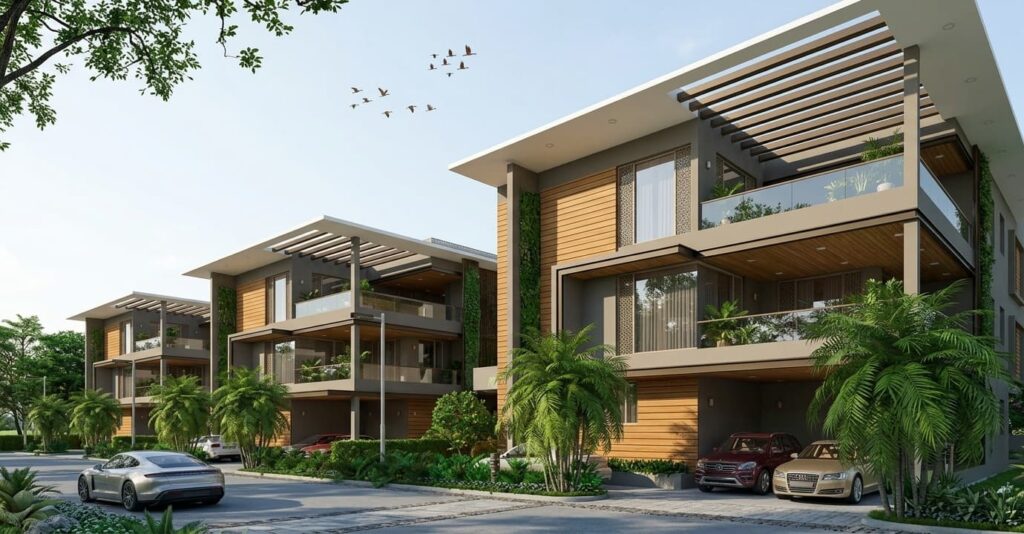
Buyers who prefer structured environments with readily available lifestyle facilities often shift their attention toward premium villas for sale or secure plotted developments within gated communities. These projects blend the autonomy of owning land with the modern luxuries of a high-rise condominium, including access to a clubhouse, multi-tier security, paved walkways, power backup, and dedicated maintenance staff. This model offers peace of mind because the developer assumes the responsibility of landscaping, installing electrical transformers, and providing internal security systems.
What are the security and maintenance advantages of gated community plots?
In an independent development, land security remains a constant concern. Encroachments, illegal parking, and garbage dumping on vacant land require regular monitoring and physical presence. Gated communities solve this issue by offering secure outer perimeter walls, gated checkpoints, and CCTV monitoring. This level of surveillance keeps your land parcel safe even if you do not plan to construct your home immediately.
From an aesthetic and long-term utility perspective, gated community plotted projects ensure uniform development. Neighboring owners must construct within defined architectural standards, preventing the haphazard construction of commercial shops or industrial workshops in a purely residential street. This uniformity keeps the neighborhood clean, organized, and pleasant, ensuring that your property values continue to rise systematically over the coming decades.
Strategic Investment Checklist and Expert Advice
How can you protect yourself from fraudulent land deals?
To avoid common legal pitfalls during documentation, you should get in touch with our real estate consultants who specialize in regional land acquisition rules and local authority procedures in Uttar Pradesh. An expert eye can quickly identify inconsistencies in the chain of title, spot hidden clauses in the agreement to sell, and verify whether the property has any pending tax liabilities or municipal dues. Professional guidance ensures that you do not sign agreements that heavily favor the seller or omit important safety nets regarding possession timelines.
Additionally, never skip the mutation of the property after your registry is complete. The registry is simply the proof of transaction, whereas mutation registers your name in the local land revenue records as the new taxpayer. Without a formal mutation certificate, you may face hurdles when applying for a building approval plan or utility connections. Keep all payment records clear, execute all financial transactions through banking channels, and avoid any cash-based side-agreements to maintain complete legal compliance throughout the process.
Frequently Asked Questions
Q1: Can an NRI purchase a residential plot in Greater Noida West?
Yes, under the guidelines issued by the Reserve Bank of India (RBI) and the Foreign Exchange Management Act (FEMA), Non-Resident Indians (NRIs) are permitted to purchase residential or commercial properties in India, including vacant plots. However, NRIs cannot buy agricultural land, plantation properties, or farmhouses without receiving specific, prior permission from the central bank and relevant local authorities.
Q2: How do I verify if a plot is free from bank mortgages?
To verify if a plot has been pledged as collateral for a bank loan, you must check the Encumbrance Certificate (EC), which lists all registered transactions and financial liabilities associated with the property. Additionally, you should search the Central Registry of Securitisation Asset Reconstruction and Security Interest (CERSAI) database, where banks in India are legally mandated to register all equitable mortgages.
Q3: Is there a specific time frame within which I must construct a house on a GNIDA plot?
Yes, the Greater Noida Industrial Development Authority (GNIDA) enforces strict construction timelines for allotted plots. Typically, plot owners must complete a minimum prescribed level of construction (usually thirty to fifty percent of the permissible ground coverage) within three to five years from the date of the execution of the lease deed, failing which the authority imposes steep non-completion charges or, in extreme cases, cancels the allotment.
Q4: What is the significance of the Khatauni number in land records?
The Khatauni number is a vital identification number assigned to a specific group of cultivators or landowners in Uttar Pradesh. It details the complete ownership structure, land share distribution, and operational liabilities of a land parcel. Checking the Khatauni ensures that the person selling the plot is indeed registered as the official owner in the state land revenue records.