
Quick Summary
Privacy acts as the foundational requirement for contemporary residential success. Discerning buyers prioritize layout orientation, sound insulation, and visual seclusion over superficial aesthetics. This deep dive covers the evolution of the home as a private sanctuary, the role of site planning in minimizing neighborhood oversight, and how technological advancements support personal seclusion within dense urban environments.
The Psychology of Seclusion in Residential Design
Modern housing demands have shifted significantly toward the concept of the home as a personal fortress. While earlier generations valued large communal gathering spaces and open-door neighborhood interactions, the current landscape reflects a desire for controlled environments. Privacy provides a buffer against the constant sensory input of contemporary life. When individuals evaluate potential properties, they first assess the degree to which their daily routines remain hidden from public view. This is not merely about physical barriers, but about the creation of zones that allow for mental decompression.
A well-planned residential space acknowledges that visual contact with neighbors creates stress. Architects and developers now focus on sightline management. By angling windows away from adjacent structures and utilizing tiered landscaping to block views, professionals create a sense of detachment even in proximity to others. Those researching latest property market updates often note that homes with higher privacy ratings command a premium. The psychological benefit of feeling invisible within one’s own living room significantly outweighs the convenience of proximity to retail hubs or arterial roads.
Why is privacy considered the ultimate modern luxury?
Luxury has evolved from a matter of gold fixtures to a matter of time and space. Privacy represents the absolute control over who enters one’s personal sphere and what information is shared with the outside world. In densely populated regions, the ability to walk through one’s garden without being observed by a neighbor is becoming an extreme rarity. Consequently, developments that treat privacy as a core structural element gain immediate favor among high-net-worth individuals.
Strategic Site Planning and Architectural Layouts
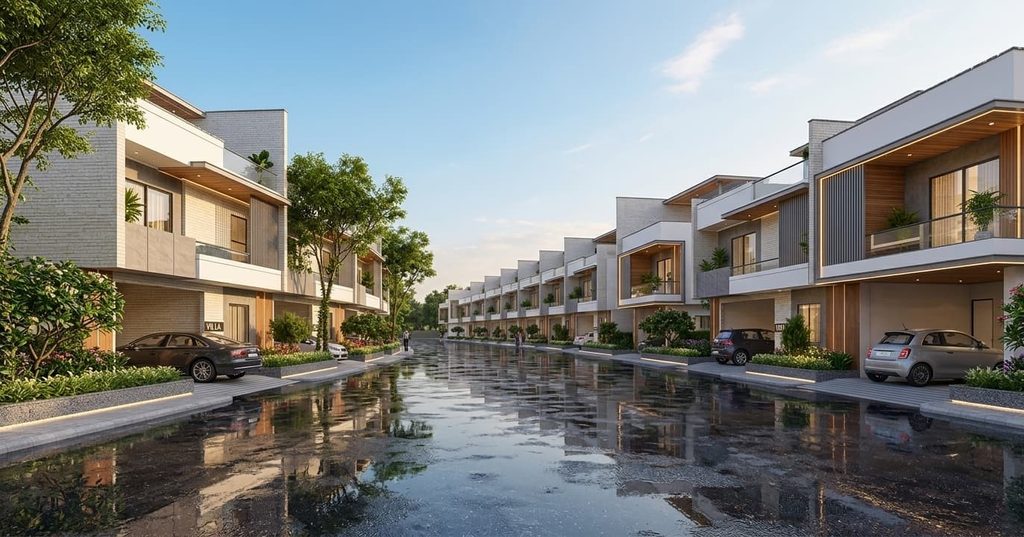
The foundation of a private residence begins long before the walls are erected. Site planning plays a critical role in how a house functions over time. A common error in suburban development involves placing structures in a rigid grid that maximizes density but sacrifices the interior experience. Effective site planning, such as that seen in the exclusive residential community in Delhi NCR, utilizes offset placement to ensure that no two primary living spaces face each other directly. This geometric strategy requires careful calculation of light angles, tree placement, and building height restrictions to maintain consistent seclusion throughout the changing seasons.
Inside the residence, the transition from public to private space is paramount. The entrance sequence, often referred to as a foyer or buffer zone, acts as a filter. It prevents guests and delivery personnel from seeing into the private living quarters immediately upon arrival. Modern floor plans often move away from the completely open-concept design of the previous decade. While open spaces were favored for social fluidity, current trends lean toward defined rooms that offer acoustic separation. This ensures that a home office or a meditation space remains quiet even while the main kitchen or living area is in full use.
How do floor plans impact perceived privacy?
Floor plans directly dictate how a home feels on a daily basis. An open plan often results in noise bleed between rooms. By contrast, a semi-closed layout allows inhabitants to maintain distinct zones. A house with a well-designed flow separates public areas like the entry hall, formal dining, and powder rooms from private sanctuaries like bedrooms, libraries, and primary bathrooms. This spatial hierarchy ensures that even in larger families, individuals have access to solitude without feeling isolated from the home at large.
Acoustic Control and Sensory Buffers
Noise pollution serves as the silent enemy of home privacy. In urban environments, the constant hum of traffic, the buzz of airplanes, and the proximity of loud neighbors can turn a sanctuary into a source of frustration. True residential comfort requires an investment in building materials that neutralize external sound. Double-glazed glass is the standard starting point, but high-performance homes now integrate triple-pane acoustic windows that effectively silence the exterior world.
Beyond windows, the walls and ceilings must be engineered for dampening. The use of dense insulation, high-mass materials, and resilient channels prevents vibration transmission. A reputable real estate developer in NCR ensures that structural elements are chosen not just for durability, but for their ability to isolate sound. It is a critical factor often overlooked by buyers until they have lived in a property for several months. Additionally, landscape features such as water fountains or thick foliage barriers can act as natural white noise generators, masking unwanted sounds from the street or neighboring lots.
What are the most effective ways to soundproof a home?
Soundproofing is most effective during the initial construction phase. Key methods include the use of acoustic membranes in wall cavities, heavy-duty floor underlayment to stop impact noise, and the installation of solid-core doors. For existing homes, retrofitting can involve adding sound-dampening panels, using heavy thermal curtains, or introducing soft furnishings that absorb sound rather than reflecting it throughout the space.
Smart Security and the Digital Veil
Privacy today is as much about digital security as it is about physical barriers. The rise of home automation has created a conflict between convenience and exposure. Homeowners are increasingly wary of how their smart devices collect data. As a result, the market is shifting toward localized, offline control systems. These systems allow residents to manage lighting, HVAC, and security cameras without routing data through public cloud servers, thus maintaining a higher degree of anonymity within their own networks.
Physical security systems have also moved away from intrusive, unsightly hardware toward integrated solutions. Discrete camera systems that blend into the architectural lines of the home allow for perimeter monitoring without making the house look like a detention center. This balance of safety and aesthetics is vital. Buyers want to feel secure, but they do not want to be reminded of potential threats every time they approach their front door. The goal is a seamless security presence that operates quietly in the background, reinforcing the privacy of the property without altering its character.
How can homeowners protect digital privacy in smart homes?
Digital privacy is best managed by utilizing air-gapped systems or local hubs that do not rely on internet connectivity for basic operations. Homeowners should also conduct regular firmware updates, use strong encryption for all devices, and disable microphones on smart speakers when not in active use. Choosing manufacturers that prioritize data privacy as a core business principle is essential for long-term protection.
Legal Frameworks and Transactional Confidentiality
The legal side of residential privacy is often misunderstood. Homeowners frequently assume their property transactions are entirely private, but public records, zoning disclosures, and neighborhood covenants play a significant role. Understanding our real estate transaction terms helps buyers navigate what information is required to be public and what can be managed through private trusts or LLC ownership. This structure allows individuals to hold property titles without having their personal names appear on public tax assessments or municipal records.
Furthermore, residential zoning laws determine what can be built next to a property. A buyer might find the perfect private house, only to have a high-rise tower built on the adjacent lot a few years later. Reviewing long-term master plans and restrictive covenants is a necessary step in the due diligence process. These documents can prevent neighbors from installing high-intensity lighting or large commercial structures that would diminish the privacy of the home. Protecting one’s living environment requires a proactive engagement with the regulatory landscape that defines the neighborhood.
Future Trends in Private Living
Looking ahead, the demand for privacy will likely drive innovations in smart glass, sustainable subterranean spaces, and modular housing that allows for rapid reconfiguration. Smart glass, which can turn opaque with the flick of a switch, is already replacing the need for traditional curtains and blinds. Subterranean spaces, once relegated to storage, are being transformed into high-privacy cinema rooms and offices that benefit from natural insulation and total light control.
Modular architecture offers another path forward. By creating homes that are built in controlled factory environments, the quality of acoustic and thermal seals is significantly higher than field-constructed homes. These structures can be positioned and oriented on a site with surgical precision to maximize privacy. As urbanization continues to increase, the definition of a premium property will be increasingly dictated by the level of autonomy the structure offers from the surrounding noise, sight, and influence of the outside world.
| Privacy Feature | Primary Benefit |
|---|---|
| Acoustic Glazing | Reduces external noise pollution and stress |
| Strategic Landscaping | Provides visual screening without blocking light |
| Local Smart Hubs | Maintains digital data within the home network |
| Offset Building Lines | Eliminates direct sightlines between neighboring rooms |
Frequently Asked Questions
1. How can I assess the privacy of a property during a short viewing?
Observe the orientation of windows. If the primary living area windows look directly into a neighbor’s kitchen or bedroom, the privacy is compromised. Also, visit the property at different times of the day to gauge the ambient noise level, as traffic or commercial activity can drastically change throughout the day.
2. Are there specific architectural styles that prioritize privacy?
Mid-century modern homes with internal courtyards are excellent for privacy because they focus all views inward rather than outward. Similarly, contemporary designs that use heavy perimeter walls and roof-mounted skylights allow for abundant natural light while keeping the interior completely concealed from the street.
3. Can smart security devices actually decrease privacy?
Yes, improperly configured smart devices can collect data on your habits and transmit it to third-party servers. To mitigate this risk, ensure that all devices are on a segmented network, use strong, unique passwords, and select brands that offer local, offline storage options for video feeds and sensor data.
4. How much should I invest in landscaping for privacy?
Landscaping is an investment that matures over time. Fast-growing hedges, like cedar or bamboo, can provide an effective screen within two to three years. Consult with a landscape architect to choose species that are suitable for your local climate and require minimal maintenance, as this provides a long-term return on your investment in terms of both property value and personal seclusion.