
Quick Summary
Deciding between a duplex villa and an apartment involves analyzing more than just the purchase price. While apartments offer lower entry costs and shared maintenance burdens, duplex villas provide superior long-term appreciation due to complete land ownership. This comprehensive guide breaks down upfront capital requirements, recurring maintenance fees, legal structures, and 10-year financial projections to help you make an informed real estate investment.
Decoding the Financial Divide: Duplex Villa versus Apartment
The choice between purchasing an independent duplex villa and acquiring a high-rise apartment is one of the most significant decisions a property buyer will face. Both housing formats cater to distinct lifestyles, but their financial structures, cost trajectories, and long-term value propositions differ fundamentally. Data tracked by analysts at Heritage Prime indicates that buyer preferences are shifting toward spaces that offer long-term financial security alongside physical comfort. To make an optimal decision, buyers must look beyond the initial price tag and evaluate the total cost of ownership over a multi-year horizon.
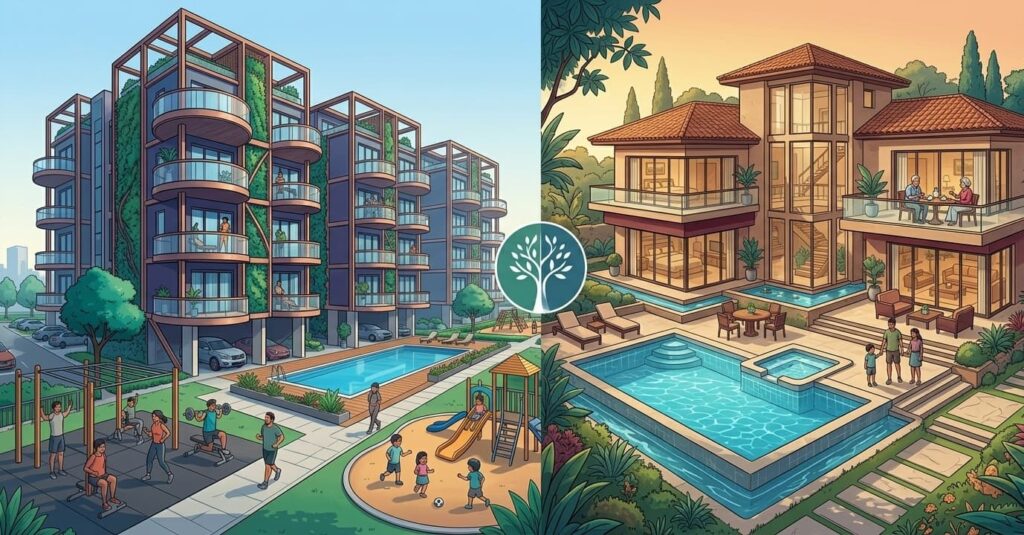
An apartment represents co-ownership in a vertical community where land is shared among dozens or hundreds of residents. In contrast, a duplex villa represents horizontal or low-rise ownership, offering direct control over both the structure and the land on which it sits. This structural difference affects everything from property taxes and monthly maintenance obligations to renovation freedom and capital gains upon resale.
Upfront Acquisition Costs and Capital Expenditures
How does the initial purchase price differ between a duplex villa and an apartment?
The initial purchase price of a duplex villa is almost always higher than that of an apartment with similar carpet area in the same locality. This discrepancy is driven by the cost of land. When you buy a duplex villa, you pay for the entire plot area plus the construction costs of the two-level structure. When you buy an apartment, the land cost is divided among all unit owners in the tower, making the entry-level price significantly lower.
Additionally, apartments are highly standardized, which allows developers to benefit from economies of scale during construction. Duplex villas, even within a gated township, require individual foundation work, independent roofing, and dedicated utility installations, which increases the construction cost per square foot.
What are the differences in registry charges, stamp duty, and GST?
Stamp duty and registration charges are calculated as a percentage of the property value declared in the sale deed. Since duplex villas generally command higher transaction values, the absolute stamp duty payment is higher. Furthermore, in some municipal jurisdictions, independent houses attract separate development charges or external development charges (EDC) that are billed directly to the owner, whereas in apartment complexes, these charges are bundled into the super built-up cost and distributed among all buyers.
Goods and Services Tax (GST) also plays a critical role if you are buying an under-construction property. Completed properties with an occupancy certificate do not attract GST. However, for under-construction units, the tax structure can vary between independent structural contracts and developer-led apartment constructions, directly impacting your overall initial outflow.
| Cost Component | Duplex Villa | High-Rise Apartment |
|---|---|---|
| Land Cost Allocation | 100% borne by the individual buyer | Fractional share (Undivided Share of Land) |
| Construction Cost Efficiency | Lower efficiency, higher customized material costs | High efficiency due to mass scale construction |
| Stamp Duty & Registration | Higher absolute value based on full land + structure cost | Lower absolute value based on unit cost |
| Inherent Flexibility | High: easy to expand horizontally or vertically later | None: restricted to the existing internal layout |
Recurring Maintenance and Operational Expenses
How do monthly maintenance charges compare?
Apartment living is synonymous with structured maintenance charges. Residents associations or professional facility management companies charge a recurring fee, usually calculated per square foot of the super built-up area. This fee covers the upkeep of common elevators, diesel generator backup systems, swimming pools, gymnasiums, round-the-clock security, and garbage disposal. While this fee can be substantial in luxury complexes, the sharing of costs across hundreds of apartments makes it predictable and manageable.
For a duplex villa, maintenance is highly variable. If the villa is located inside a gated community, you will pay a monthly common area maintenance fee similar to apartment owners. However, if the villa is an independent standalone structure, you are solely responsible for hiring security guards, maintaining water pumps, cleaning the terrace, and managing waste disposal. While this eliminates monthly society maintenance fees, it introduces unpredictable, ad-hoc costs that can exceed planned budgets.
Who bears the cost of structural repairs and external painting?
In an apartment building, the sinking fund collected from all owners pays for major structural repairs, external painting, and waterproofing of the tower. This collective pool ensures that individual owners are not hit with sudden, massive repair bills. The decision to repaint the building is made democratically by the resident welfare association.
In a duplex villa, the structural liability rests entirely on your shoulders. If the roof develops a leak, if the external plaster begins to flake, or if the foundation requires reinforcement due to water logging, you must fund the entire repair. External painting for a duplex villa, which must be done every five to seven years to preserve the exterior structure, requires a substantial individual capital outlay.
Real Estate Appreciation and Long-Term Wealth Generation
Why does land ownership accelerate value growth in duplex villas?
The fundamental law of real estate appreciation states that land appreciates while buildings depreciate. Physical brick and concrete structures wear out over time, losing their aesthetic and structural value, but land is a finite resource that consistently gains value as urban centers grow. When you invest in a duplex villa, a large portion of your purchase price is allocated to land ownership. Over a ten-year cycle, the rapid appreciation of this plot of land far offsets the physical depreciation of the villa building, leading to superior capital gains.
For investors seeking customized structural flexibility alongside high land value retention, looking at options like independent homes with modern amenities can offer a reliable path to long-term wealth creation, combining community infrastructure with private plot ownership.
What is Undivided Share of Land (UDS) and how does it affect apartment value?
Apartment buyers do not own a specific plot of land. Instead, they own an Undivided Share of Land (UDS). This is the share of the total land on which the entire residential tower complex is built, allocated proportionally based on the size of the individual apartment. When the apartment building reaches the end of its structural life, usually after forty to fifty years, the collective owners only own their respective UDS.
Because the UDS in high-density high-rises is small, the long-term appreciation potential of apartments is lower compared to independent duplexes. Before signing any booking agreement, buyers must thoroughly review the legal terms and service conditions governing the transfer of undivided share of land to ensure clear title rights and avoid future disputes with co-owners or developers.
Hidden Costs, Security Infrastructure, and Ancillary Spending
What are the hidden costs of setting up private security and power backup?
When moving into an independent duplex villa, security is a major consideration. To secure a multi-level independent structure, you must install private closed-circuit television (CCTV) cameras, motion-sensor lighting, boundary wall fencing, and smart video door phones. In contrast, modern high-rise apartments come pre-equipped with multi-tiered security systems, including manned main gates, intercom facilities, and restricted elevator access, all covered under the standard maintenance budget.
Power backup is another area where costs diverge. Apartment complexes have commercial-grade generator systems that switch on automatically during power outages. To achieve the same level of uninterrupted power backup in a duplex villa, you must invest in high-capacity home inverters or private silent diesel generators, which require routine servicing, battery replacements, and fuel management.
How do municipal taxes and utility tariffs differ?
Property taxes are calculated differently for independent villas and apartments. Municipal corporations often charge higher property taxes on independent structures because they occupy more ground area per unit of habitation. Water supply connections can also be more expensive to secure and maintain individually, as apartment buildings benefit from centralized bulk water supply agreements with municipal authorities.
When registering on real estate platforms to check tax history, users should review how their information is handled according to strict user data protection guidelines to ensure their property portfolios and personal financial data remain secure and confidential from public scrapers.
Lifestyle Value versus Financial Outlay
Is the cost per square foot more efficient in high-density apartments?
From a pure space purchase perspective, apartments offer a highly optimized cost per square foot because they utilize vertical air space rather than horizontal land area. However, it is vital to distinguish between super built-up area and carpet area. In apartments, the super built-up area includes common lobbies, corridors, elevator shafts, and clubhouses, meaning you might pay for 2,000 square feet but only receive 1,400 square feet of actual usable indoor space inside your home.
In a duplex villa, the difference between super built-up area and carpet area is much smaller. You pay for the land and the actual built area of your private structure. There is no leakage of capital toward common corridors or shared stairwells, giving you greater control over the exact layout of every square inch of your home.
How does space utilization impact the functional value of your investment?
A duplex villa excels in functional layout flexibility. The division of space across two floors allows for a natural separation of active public zones and quiet private quarters. For instance, the ground floor can host the living room, dining area, and kitchen, while the first floor houses the family lounge and bedrooms. This vertical distribution provides privacy that is difficult to replicate in a single-level apartment layout, where bedrooms are adjacent to public living areas.
Buyers looking for premium independent living can analyze options like the exclusive residential community in Delhi NCR which showcases how plot ownership adds long-term value, offering spacious floor plans that allow families to grow without the constraints of high-density living complexes.
Financial Scenario Modeling: 10-Year Ownership Projection
To understand the true cost differences, we must project expenses over a ten-year holding period. Let us assume a baseline comparison where both properties are located in a comparable suburban micro-market. The duplex villa is purchased for 1.5 units of currency, while the apartment is purchased for 1.0 unit of currency. The table below outlines how compounding maintenance, taxes, and differing appreciation rates affect the total asset value after a decade.
| Financial Metric (Over 10 Years) | Duplex Villa (1.5 Unit Base) | Apartment (1.0 Unit Base) |
|---|---|---|
| Average Annual Appreciation | 8% to 10% (driven by land value) | 5% to 6% (limited by structural age) |
| Cumulative Maintenance Paid | Moderate (higher self-managed repairs) | High (compounding monthly society fees) |
| Rental Yield Potential | 1.5% to 2.5% (lower rental liquidity) | 3.0% to 4.0% (higher rental demand) |
| Asset Value after 10 Years | Approximately 3.24 units of currency | Approximately 1.79 units of currency |
The modeling clearly shows that while the duplex villa requires a larger upfront capital commitment and involves more hands-on maintenance, its long-term asset value growth is significantly higher. The apartment, conversely, represents a more liquid asset with better immediate rental income potential, but lower terminal wealth generation due to the depreciation of the building structure over the ten-year period.
Frequently Asked Questions (FAQ)
Is a duplex villa more expensive to maintain than a luxury high-rise apartment?
In the short term, luxury apartments often carry higher recurring monthly maintenance charges due to premium shared amenities like temperature-controlled pools, concierge services, and high-speed elevators. However, over a longer period of ten to fifteen years, a duplex villa can become more expensive because the owner must bear the entire cost of major structural repairs, exterior painting, and roof waterproofing, which are shared among all owners in an apartment complex.
How does the undivided share of land (UDS) impact the resale value of an apartment?
The Undivided Share of Land is the fractional portion of the plot owned by each apartment buyer. As an apartment building ages, the physical structure depreciates, and the market value shifts heavily toward the UDS. If the building has a high density with many apartments sharing a small plot, the UDS per owner is small, which can limit the resale price and appreciation of older apartments compared to independent villas that occupy their own dedicated plots.
Which option offers better rental yields for real estate investors?
Apartments generally offer superior rental yields, typically ranging from 3% to 4% of the property value annually. They are easier to lease because tenants prefer managed security, shared recreational amenities, and proximity to commercial business districts. Duplex villas have a smaller pool of potential tenants due to their higher monthly rental costs, resulting in lower rental yields, usually around 1.5% to 2.5% annually, though they make up for this with higher long-term capital appreciation.
Can I customize the structural layout of an apartment as easily as a duplex villa?
No, structural customization in apartments is extremely limited. You cannot alter load-bearing walls, expand balconies, or change the external facade, as these modifications affect the structural integrity and aesthetic uniformity of the entire building. In contrast, a duplex villa offers complete freedom to modify interior spaces, build additional rooms, alter the facade, or build upward, provided you adhere to local municipal building codes and zoning laws.