
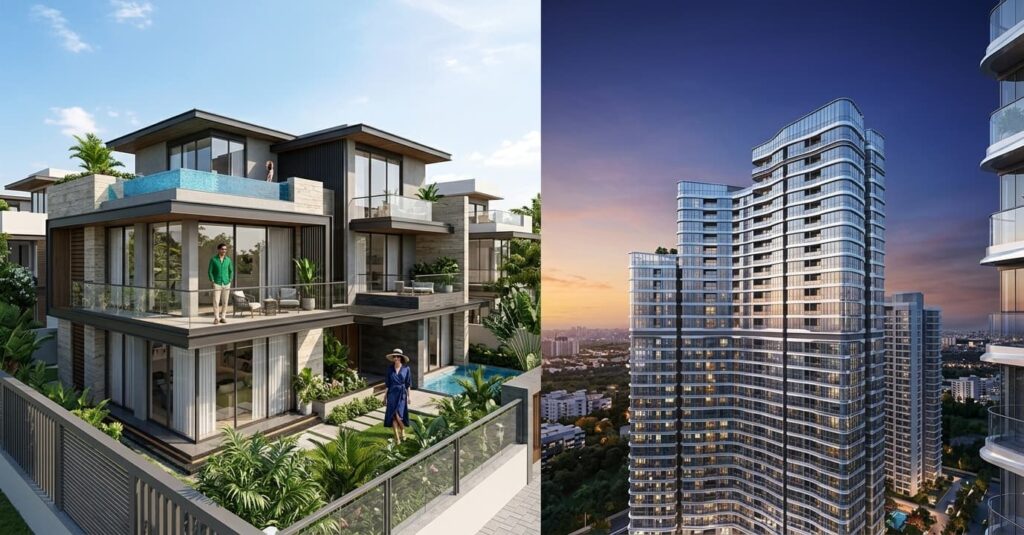
Quick Summary
Choosing between a villa and an apartment involves balancing spatial autonomy, financial investment strategies, lifestyle priorities, and maintenance responsibilities. While villas offer unmatched privacy, land ownership, and customization, apartments provide convenience, centralized security, and structured community living. This guide breaks down these factors to help you identify the ideal residential option for your long-term goals.
Table of Contents
- Space, Layout, and Design Autonomy
- Financial Considerations and Long-Term Investment Value
- Lifestyle, Community Integration, and Security
- Location Dynamics and Proximity to Urban Centers
- Head-to-Head Comparison: Villa vs Apartment Living
- Decision Matrix: Which Residential Option Fits Your Lifestyle?
- Frequently Asked Questions
Space, Layout, and Design Autonomy
How does space distribution differ between villas and apartments?
The structural blueprint of a home dictates how a household functions daily. In a traditional high-rise development, space optimization is vertical and predefined. Apartments are engineered to maximize every square foot within a standardized layout. While premium apartments offer generous carpet areas, they remain bound by shared structural walls, fixed ceiling heights, and predetermined utility lines. This horizontal alignment means that indoor living is closely integrated with neighborly proximity, and outdoor spaces are limited to balconies or shared terraces.
Conversely, independent residences present a completely different spatial dynamic. They distribute square footage across multiple vertical levels, incorporating private yards, dedicated driveways, and personal rooftops. This multi-level configuration permits a distinct separation between private quarters and social hosting zones. When you explore modern luxury housing spaces by Heritage Prime, you observe that spatial volume is prioritized, allowing for expansive double-height ceilings, dedicated home offices, and custom entertainment lounges that are rarely feasible in standard apartment configurations.
What design and customization freedom do villa owners enjoy?
Design autonomy is a major separating factor between these two housing formats. Apartment buyers must conform to the architectural guidelines of the residential society. Major structural alterations, external modifications, or expanding the footprint are strictly prohibited to ensure structural integrity and aesthetic uniformity. Internal modifications are often restricted by load-bearing walls and shared utility shafts, limiting your renovation potential to surface-level changes like painting, cabinetry, or flooring.
An independent home grants you absolute creative control over the property. As the land owner, you can modify the architectural style, reconfigure interior layouts, build additional rooms, or completely alter the facade. Partnering with a reputable real estate developer in NCR ensures that your structural customized options comply with local building regulations while fulfilling your design vision. Whether adding a private lap pool, designing a bespoke courtyard garden, or installing private solar grids, the freedom to innovate remains unchecked by community bylaws.
Financial Considerations and Long-Term Investment Value
Is a villa a better financial investment than a high-end apartment?
From an investment perspective, the underlying value of any real estate asset lies in the land component. When purchasing an apartment, your investment includes the built-up structure and an undivided share of land (UDS) shared among hundreds of other co-owners. Over time, the concrete structure of the apartment complex depreciates, meaning the long-term value is heavily tied to the maintenance of the building and the ongoing demand for that specific neighborhood.
Independent homes represent direct ownership of the physical plot. While the building structure itself undergoes natural wear and tear, the underlying land value steadily appreciates over time. This makes land-based properties exceptionally resilient against economic fluctuations. In high-growth zones, investing in luxury independent villas in Noida offers strong capital growth, as undeveloped land plots in organized sectors become increasingly scarce, driving up demand and premiums for individual land ownership.
Understanding recurring maintenance costs and hidden expenditures
The financial commitment of homeownership extends far beyond the initial purchase price. Apartments carry a recurring, predictable monthly or quarterly maintenance fee calculated on a per-square-foot basis. This fee is managed by a central Resident Welfare Association (RWA) and covers upkeep of elevators, shared clubhouses, security systems, swimming pools, and power backup units. While this pool-based system keeps costs predictable, you are financially committed to paying for shared amenities regardless of how often you use them.
Villas present a different financial structure. In an independent, standalone villa, the owner is solely responsible for all maintenance issues, including exterior painting, structural repairs, roof waterproofing, and individual garden upkeep. This can lead to unpredictable, lump-sum expenditures. However, modern gated developments, such as the Palm Villas Noida gated community, offer a hybrid model. These managed communities combine the structural security and common area maintenance of an apartment with the personal space of an independent home, keeping your maintenance obligations structured and manageable.
Lifestyle, Community Integration, and Security
How does community interaction differ in gated villa developments versus high-rise apartments?
The social fabric of these two housing types appeals to different personalities. Apartment living is fundamentally community-centric. With multiple families sharing the same towers, lobbies, and recreational zones, social interaction is natural and frequent. This high-density setup is highly beneficial for families with young children or elderly members who appreciate immediate access to a social network and regular community celebrations right outside their door.
Villa communities cater to those who prefer a quieter, more curated social lifestyle. While independent homes provide a serene escape from neighborly noise and shared walls, they do not necessarily mean isolation. Modern planned villa projects feature exclusive clubhouses, jogging tracks, and recreational centers that host social gatherings. This setup allows residents to enjoy the best of both worlds: active community participation when desired, and complete, undisturbed privacy inside their private retreat.
Which option provides superior security and privacy?
Security remains a top priority for home buyers. High-rise apartment complexes benefit from centralized, multi-tier security systems. This setup typically includes manned main gates, CCTV surveillance across common areas, intercom connectivity, and digital visitor management apps. Additionally, the physical layout of apartments, where entry points are limited to a single front door and neighbors are nearby, naturally deters unauthorized access, making apartments highly convenient for frequent travelers who want a simple lock-and-leave residence.
Independent villas require a more proactive security plan. Standalone homes have multiple entry points, ground-floor windows, and open outdoor areas that require robust, individual security measures. However, when situated inside a planned township, these concerns are minimized. Gated villa enclaves feature comprehensive peripheral security, regular security patrols, and automated access control, allowing owners to enjoy quiet privacy without compromising on personal safety.
Location Dynamics and Proximity to Urban Centers
Are apartments geographically more convenient than modern luxury villas?
Location is a key consideration when selecting a home. Due to high land acquisition costs in city centers, developers build vertically, placing apartment towers in central business districts, commercial hubs, and near major transportation lines. This makes apartments highly convenient for working professionals who prioritize short commute times, walkable access to offices, and close proximity to premium retail outlets, schools, and healthcare facilities.
Villas, due to their larger land requirements, are typically built in expanding suburban zones or planned sectors. While these locations offer cleaner air, lower noise levels, and closer proximity to nature, they can result in longer daily commutes to central business districts. However, this dynamic is changing as major cities expand and decentralize, creating self-contained micro-markets that feature premium commercial developments alongside quiet residential estates.
How has modern infrastructure altered the location debate?
The rise of modern infrastructure has reshaped how buyers view suburban and peripheral residential projects. The expansion of high-speed expressways, metro rail corridors, and elevated roads has significantly reduced travel times. Areas once considered distant are now highly accessible, offering a practical option for buyers who want the space of an independent home without losing connection to the city. This infrastructure growth has made premium villa communities an attractive choice for families seeking a balanced, modern lifestyle away from crowded city centers.
Head-to-Head Comparison: Villa vs Apartment Living
To help you evaluate these options, here is a detailed breakdown of the practical differences between independent villas and modern apartments:
| Feature | Independent Villa Living | Modern Apartment Living |
|---|---|---|
| Land Ownership | Complete, direct ownership of the plot and structure. | Undivided share of land (UDS) shared among residents. |
| Customization Power | Absolute freedom to modify architecture, layout, and expand. | Limited to interior non-structural design updates. |
| Privacy Levels | High: No shared walls, private yards, and quiet settings. | Moderate: Shared walls, common lobbies, and adjacent balconies. |
| Maintenance Setup | Individually managed or part of a gated villa program. | Centrally managed by a dedicated resident association. |
| Location Advantage | Typically in planned suburban zones and quiet sectors. | Often close to central business districts and transit hubs. |
Decision Matrix: Which Residential Option Fits Your Lifestyle?
When should you prioritize purchasing a premium villa?
An independent villa is the ideal choice for buyers who prioritize long-term asset value, personal space, and architectural freedom. If your household spans multiple generations, a multi-story layout offers the perfect balance of shared living areas and private spaces. Families who value outdoor activities, pet ownership, or gardening will appreciate the private lawns and open terraces that come with an independent home.
Additionally, if you view real estate as a multi-decade asset, owning the land offers much stronger security against inflation compared to high-rise apartments. To stay informed on these changing market dynamics, following the NCR real estate blog and market insights can help you identify high-potential areas where independent homes are set for steady, long-term capital growth.
When does a luxury apartment make more practical sense?
For buyers with busy professional schedules or who travel frequently, a luxury apartment offers unbeatable convenience. The ease of managed maintenance, on-call technical support, and centralized security allows you to easily lock up and travel without worry. If a short commute to your office is a priority, high-rise apartments near major employment hubs are highly practical, saving you valuable time every day.
Apartments also offer an instant social network, with shared spaces that make it easy for residents to connect. If you prefer a hands-off approach to property maintenance and enjoy being part of a close-knit, active neighborhood, a premium high-rise apartment provides a comfortable, well-supported lifestyle.
Frequently Asked Questions
1. Which property type yields better rental returns, villas or apartments?
Generally, apartments generate higher rental yields compared to villas. This is because apartments are typically located near employment hubs and attract a larger pool of tenants, such as working professionals and young families, who seek shorter lease terms and convenient commutes. Villas, on the other hand, require a larger capital investment, resulting in lower rental yields, but they make up for this with stronger, long-term capital appreciation of the land itself.
2. How do home loan policies and approvals differ between villas and apartments?
Securing a home loan for a high-rise apartment is often faster because banks pre-approve major developer projects after verifying the collective title deeds. For independent villas, especially standalone structures, financial institutions conduct detailed legal verifications of the land title, local building permits, and environmental clearances. However, working with established, trusted developers ensures a smooth and straightforward financing process.
3. Are villas in gated communities safer than standalone independent homes?
Yes, villas within planned gated communities are significantly safer than standalone independent houses. Gated communities feature professional, round-the-clock security, continuous CCTV monitoring, restricted entry points, and regular security patrols. This setup provides the space and freedom of an independent home alongside the reliable, centralized safety of a modern apartment complex.
4. What is the impact of property depreciation on apartments versus villas?
All physical buildings depreciate over time due to natural wear and tear. However, in the case of a villa, the depreciating value of the building is offset by the steady appreciation of the land it stands on. For apartments, the land share is divided among many co-owners, meaning the property’s overall value is more dependent on the building’s maintenance, age, and the ongoing appeal of the surrounding neighborhood.